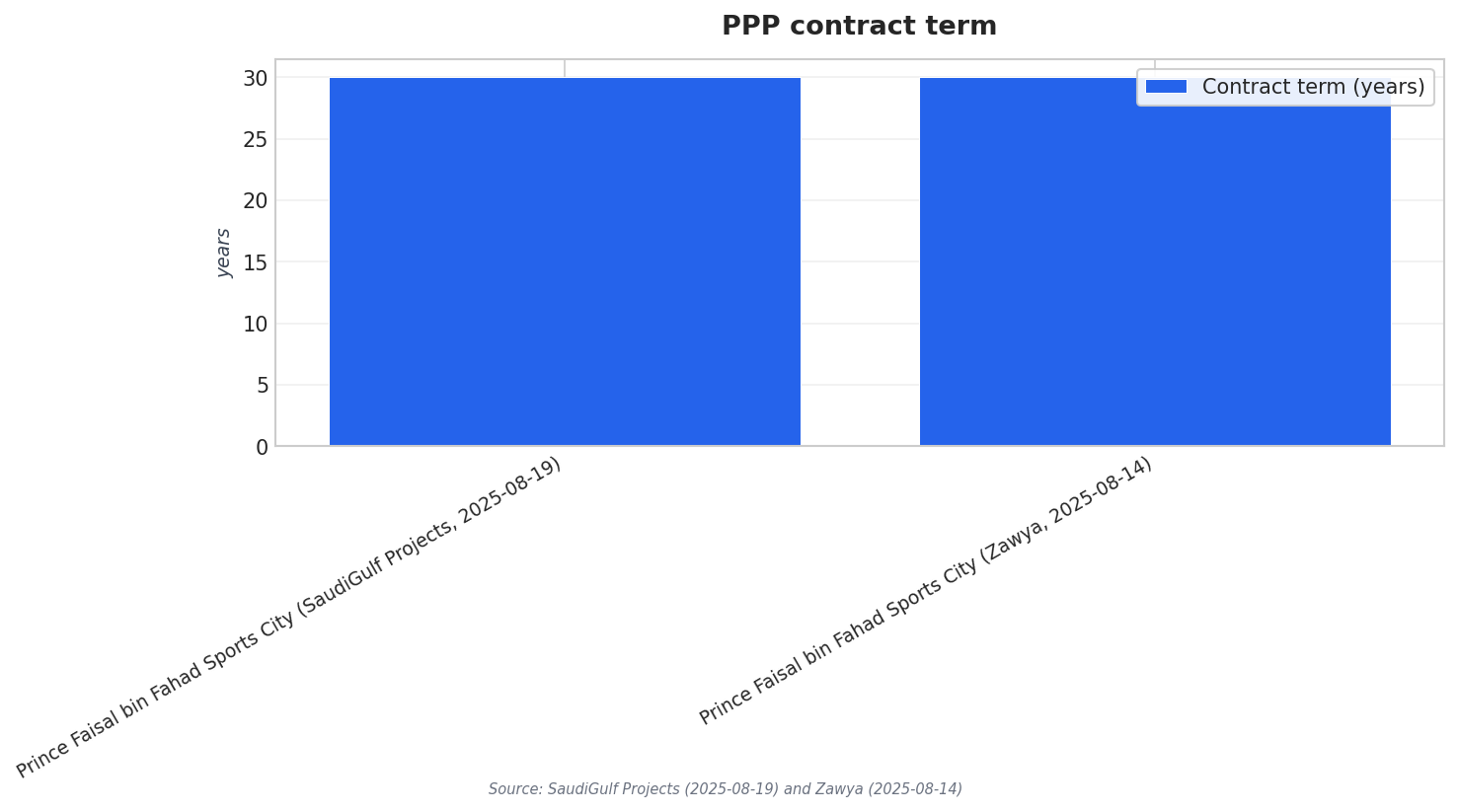
Saudi Arabia’s Ministry of Sport (MoS), working with the National Center for Privatization & PPP (NCP) and the Riyadh Region Municipality, has launched the Expression of Interest (EOI) and Request for Qualification (RFQ) phase for the Prince Faisal bin Fahad (PFBF) Sports City project in Riyadh. The structure is a Design, Build, Finance, Operate, Maintain (DBFOM) model with a 20–30 year contract term. For stadium developers, this sets a clear expectation: the private partner is not only delivering an asset, but also carrying long-term operational and maintenance accountability. The procurement is positioned to attract both local and international investors through NCP’s channels.
The scheme includes a new stadium planned north of King Abdullah Park in Al-Malaz, adjacent to the current facility, while also requiring a wider master plan for PFBF Sports City that covers both the new and existing stadiums. Early notices described a seating capacity of approximately 47,000 spectators for the new stadium. Later reporting tied the PPP scope to a FIFA World Cup Group Stage Round of 32-compliant stadium with a 42,371-seat capacity (total 46,870) alongside its associated assets. Another reference noted a proposed capacity of 46,865 people following refurbishment. Taken together, these figures underline an important delivery reality: capacity is being communicated in closely related but distinct ways depending on definition and stage, so developers should treat “seat count” as a requirement to be validated during qualification and procurement.
Procurement Signals: Timeline Discipline and Bankable Lifecycle Roles
For bidders, the immediate takeaway is the schedule and the market-facing discipline around submissions. MoS and NCP asked interested parties to submit Statements of Qualification (SOQ) by October 13, 2025 at 3:00 PM KSA time. Commentary on the expected process also sketched a sequence that moves from EOI submission into technical and financial pre-qualification assessment, then an RFP for shortlisted bidders, followed by contract award, financial close, and execution. Even without detailed scoring criteria in public notices, this pathway shows how the Saudi client team is aligning stadium procurement with a long-term DBFOM approach, where financing, operations, and maintenance are integral to the developer’s bid strategy rather than add-ons.
From a World Cup stadium developer perspective, the project is explicitly linked to major domestic and international football events, including matches during the 2034 FIFA World Cup. One trade report described PFBF as the first in a pipeline of PPP-delivered stadiums expected ahead of 2034. It also referenced Saudi Arabia’s host plan that envisages 15 tournament venues across five host cities, combining existing, under-construction, and new builds. That context matters: it suggests the Prince Faisal bin Fahad Sports City procurement is not only about delivering one venue, but also about proving a repeatable delivery mechanism that mobilizes private capital and expertise under lifecycle-based obligations.
Competitive signals are already visible. Nesma & Partners and FCC Construcción signed an agreement to jointly submit prequalification for the PPP, explicitly referencing the DBFOM scope and the FIFA World Cup Group Stage Round of 32-compliant stadium. Public statements around the broader sports city aim at commercial sustainability and increasing revenues, alongside preparing the site to host major sporting and diverse cultural events. For developers assessing the Prince Faisal Sports City PPP as a case study, the lesson is simple: success depends on delivering a stadium and a wider precinct plan, then operating it over 20–30 years in a way that supports event readiness while also standing up commercially beyond tournament moments.
Who are the public partners leading the Prince Faisal Sports City PPP procurement?
What delivery model and contract term are being used for the project?
What stadium capacity has been cited for the new development?
What is the SOQ deadline for interested bidders?
How does the Prince Faisal Sports City PPP connect to World Cup stadium delivery planning?