Physical education reform in Saudi schools sits inside a wider education expansion story. One market report forecasts Saudi Arabia’s education sector to grow at a 7.1% CAGR between 2025 and 2032. Demand pressure is tied to demographics and capacity. The Saudi population reached 35.3 million in 2024, and the same source projects population growth at an annual rate of 2.5%. It also projects K-12 student registrations reaching 8.3 million in 2030 from 6.1 million in 2018, implying the need for an additional 2.2 million seats across the Kingdom. For sports education vendors, more seats and new campuses translate into more gyms, fields, and curriculum delivery needs that must be specified, procured, and maintained.
Urbanization also shapes where facilities and sports programs will concentrate. The Ministry of Municipal and Rural Affairs figure cited in the education report states that around 82.1% of the population lives in urban areas, while 17.9% lives in rural areas, with the urban share forecast to grow further under transformation plans. Vendors mapping routes to market can use this as a practical targeting signal for distribution, installation, and service networks. At the same time, the education system has been centered on offline teaching methods, but digital learning is described as steadily gaining traction due to accessibility and more engaging learning experiences. That matters for physical education suppliers offering digital lesson planning, assessment tools, or blended training content alongside on-site delivery.
Vendor Market Map: Where Demand Concentrates and How It Buys
Private education is a major demand node for sports programming and equipment. One Saudi education-sector report says the number of private institutes reached over 7,337 schools in 2024, up by 490 schools over 2023, with student enrolment in private institutions reaching over 1 million in 2024. A separate KSA private K-12 market report forecasts growth from USD 9.17 billion in 2025 to USD 9.94 billion in 2026, reaching USD 15.45 billion by 2031. In that private K-12 view, British programs accounted for 32.94% of market size in 2025, while American curricula are forecast to post an 11.24% CAGR to 2031. For vendors, curriculum variety can translate into different PE lesson structures, sports preferences, and compliance checklists across school groups.
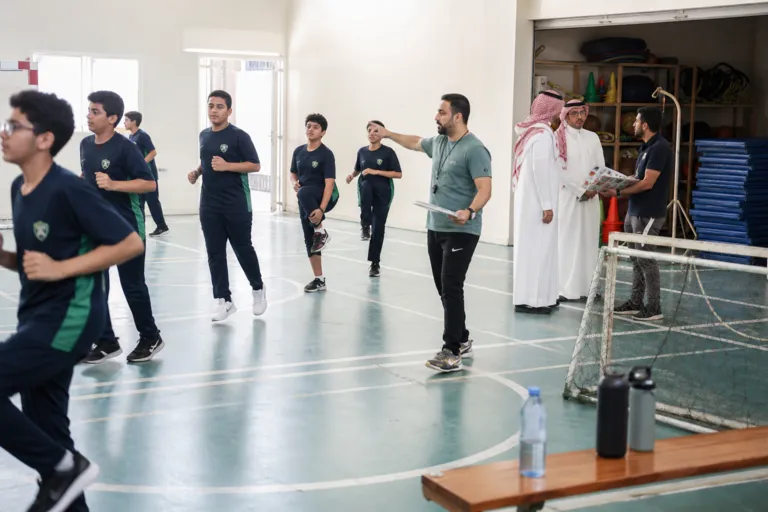
Procurement signals also come from the sports funding side. Ken Research reports that, in 2023, the Saudi government implemented a new regulation aimed at enhancing sports participation among youth, including a budget allocation of USD 200 million to develop sports facilities in schools and communities. The same source positions schools and colleges as significant users of sports equipment, even while individual consumers represent the largest segment overall. This creates a clear vendor split: facility-build and outfitting packages for institutions, and complementary community access or after-school extensions. The keyword topic—how the school sports curriculum in Saudi Arabia is evolving—often becomes tangible through what facilities get built and what equipment is standardized for school use.
Global context can help vendors benchmark product strategy, but it should not be treated as a local Saudi figure. DataIntelo values the global school sports equipment market at $9.8 billion in 2025 and projects $16.4 billion by 2034, at a 5.9% CAGR from 2026 to 2034. It also states that high schools and colleges accounted for about 54.7% of total procurement volume by value in 2025, and notes a shift toward sport-specific, age-calibrated purchasing and premium, safety-certified equipment. Separately, a Springer Nature review of Saudi education reform highlights an “implementation gap” between ambitious policy goals and on-the-ground realities, based on literature from 2017 to 2025 and interviews with 15 stakeholders. For vendors, that gap is a reminder to pair products with training, adoption support, and measurable outcomes.
What is driving demand for physical education resources in Saudi schools?
How big is private-school expansion as a sales channel for PE vendors?
What public funding signal exists for school sports facilities in Saudi Arabia?
How should vendors think about the school sports curriculum in Saudi Arabia when planning go-to-market?
What global procurement trends can inform equipment positioning (without assuming they apply locally)?