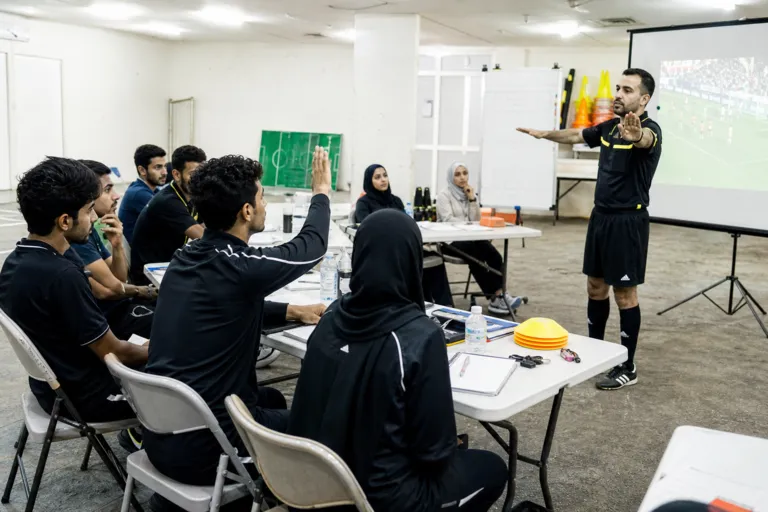
Competent match officials are a foundational requirement for football. FIFA links the training and education of highly qualified match officials with ongoing developments in playing and coaching, and it frames refereeing as essential for the uniform application of the Laws of the Game and for protecting players on the pitch. FIFA also describes how structured education can be delivered through its Referee Education & Development Programme, using enhanced online learning tools, professionally curated video materials, and frequent workshops at confederation, regional, and member association levels. That blend of digital learning and in-person calibration points to a clear opportunity for training providers who can help operationalize similar approaches in Saudi Arabia.
Macro investment trends in the Kingdom strengthen the business case for scalable officiating education. Mordor Intelligence projects the Saudi Arabia event management market will grow from USD 2.59 billion in 2025 to USD 2.77 billion in 2026 and reach USD 3.92 billion by 2031, forecasting a 7.14% CAGR over 2026–2031. In 2025, corporate end-users accounted for 58.42% of market share, while ticket sales represented 54.92% of revenue. The same source reports average venue utilization at 68% in Riyadh and 61% in Jeddah as of 2025. As event volumes and utilization rise, organizers have more at stake in match integrity and consistent decision-making, which increases the value of reliable referee education pathways.
Why Venue Expansion Creates Urgency for Officiating Skills
Saudi Arabia’s development pipeline also signals how quickly the operating environment is changing. Mordor Intelligence notes that more than 100 new event-ready facilities are slated for completion under giga-projects such as NEOM, Qiddiya, and the Red Sea destination, and it references King Salman International Stadium with a 92,760-seat bowl. In parallel, Trade.gov highlights major global events such as World Expo 2030 and World Cup 2034 as part of the opportunity landscape tied to Vision 2030 reforms and investment. New venues and high-profile tournaments do not just require security, operations, and ticketing. They also require trained match officials and instructors who can deliver consistent standards under pressure, across a growing calendar of fixtures and event formats.
Training providers can also take cues from how other Saudi sectors are responding to skills gaps. In construction, Mordor Intelligence reports an active workforce that reached 2.8 million in 2024, while overlapping mega-projects exposed gaps in specific technical capabilities. The same report states Saudization rules raise the local labor quota to 30% by 2027, and it describes contractors investing in training academies that certify 500 workers annually in critical skills. While refereeing is a different discipline, the pattern is relevant: large-scale national build-outs surface capability gaps, and structured academies are one proven response. In officiating, that could translate into standardized curricula, instructor development, and regular workshops aligned to modern match demands.
For providers positioning in referee development programs Saudi Arabia stakeholders can adopt, the clearest product-market fit is an end-to-end pathway built around learning design, assessment, and field calibration. FIFA’s approach emphasizes online learning tools, curated video materials, and frequent workshops, serving both match officials and referee instructors. Event growth and venue utilization data suggest expanding operational demand, while giga-project facilities and global event plans increase the reputational importance of consistent officiating. Providers that can support member-association-level delivery, train-the-trainer models, and workshop cadence can align offerings to how FIFA frames referee education while meeting the practical needs created by Saudi Arabia’s expanding sports and events ecosystem.
Why is referee education tied to player safety and match quality?
What elements does FIFA emphasize in referee education and development?
What market signals suggest more demand for trained match officials in Saudi Arabia?
How do giga-project venues affect the need for officiating capability?
How can referee development programs in Saudi Arabia be structured to fit the moment?