Aquatic centre development in Saudi Arabia is increasingly influenced by how hospitality and mixed-use projects treat pools as income generators, not just amenities. One industry analysis notes that hotel developers are integrating multi-pool layouts, splash zones, and cabana villages to drive incremental guest spending through day passes and premium room packages. It also highlights that properties under construction in Saudi Arabia allocate entire rooftop levels to aquatic amenities, reflecting a major specification rate for pools across Vision 2030 projects. For operators, this shifts planning from “build and maintain” to “design for monetization,” including programming and space that supports paid experiences.
In design terms, rooftop placement can also support positioning and pricing. In dense metropolitan contexts, rooftops are used for visual differentiation, and one source reports that hotels with elevated pools can command 25–40% higher average daily rates than comparable hotels without elevated pools, while also creating year-round revenue options through private event bookings and premium cabana rentals. Design decisions therefore extend beyond the pool tank and deck into circulation, event readiness, and flexible zones that can switch between day-use, lessons, and private hire. Even when the project is not a hotel, these levers matter because they create clear product tiers.
Operating Costs: Design for Lower Labor, Energy, and Chemical Use
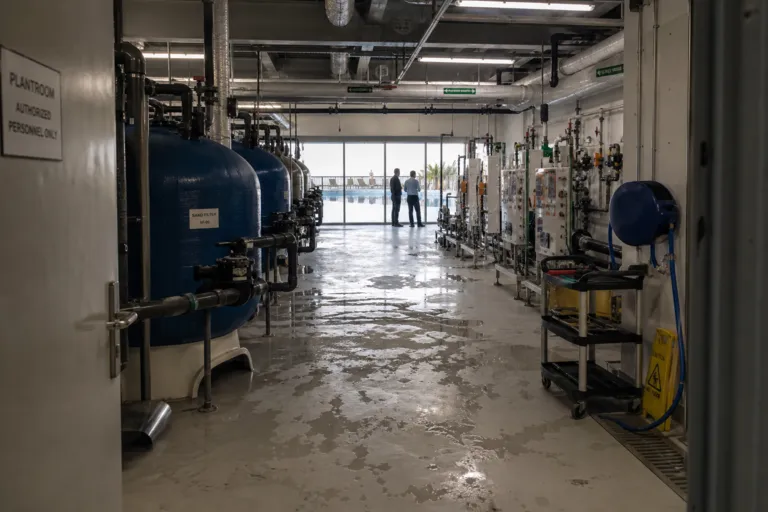
Operating costs are a core constraint, and the sources repeatedly link cost control to automation and efficient equipment. A market report describes how innovations such as variable speed pumps and solar heating systems address long-standing concerns about operational costs, while water conservation technology like automatic safety covers and advanced water recycling systems is becoming a standard requirement. It also gives an operational example: a commercial hospitality operator can use an automated pool management platform with digital water testing to optimize maintenance schedules for commercial aquatic facilities, managing high bather loads while reducing labor costs and chemical usage. Material choices vary too, from reinforced concrete to fiberglass shells and vinyl liners, allowing projects to balance aesthetics and budget.
Equipment specifications can be written in performance terms, not brand terms, but the sources provide a concrete benchmark range for variable-speed technology. One market study cites Pentair’s IntelliFlo variable-speed pumps operating across a speed range from 450 to 3,450 rpm, positioning variable-speed operation as an energy-reduction alternative to fixed-speed models for residential and commercial pools. In practical facility planning, that kind of range supports day-part scheduling, lower speeds for filtration, and higher speeds for peak turnover periods. It pairs naturally with covers, recycling systems, and automated monitoring to build a cost plan that is operationally defensible.
Revenue models benefit when aquatic space is treated like a program platform. Hospitality revenue levers include day passes, premium room packages, private events, and cabana rentals, all cited in the sources as drivers of incremental spend or year-round income. Fitness operators add other pathways: one analysis says they capitalize on membership retention benefits, corporate wellness contracts, and premium programming that generates higher per-session revenues than conventional lap swimming, with aquatic therapy and senior fitness classes commanding premium pricing in aging demographics. Franchising and swim education can also be part of a centre’s mix. A franchise report states there are over 28,000 franchised swim centers globally and that the Middle East & Africa represents approximately 12% of the global swimming franchise market, with adoption concentrated in the UAE, Saudi Arabia, and South Africa; it also notes that many centers report 19% of total bookings attributable to non-lesson recreational use.
What is driving aquatic centre development in Saudi Arabia today?
How can rooftop pool design affect revenue in hospitality projects?
Which design and technology choices can reduce pool operating costs?
What speed range is cited for a variable-speed pool pump example?
How can swim-programming and franchising support pool revenue models?