Grass choices are no longer just about tradition. Stadium operators now evaluate performance testing, multi-event durability, and upkeep constraints when deciding between natural grass, hybrid builds, or full synthetic systems. For decision-makers watching hybrid pitch turf technology in Saudi Arabia, the broader global market provides clues about what is being bought and why. One report estimates the global artificial grass market at USD 3,776.94 million in 2025, projecting USD 3,984.68 million in 2026 and USD 6,482.35 million by 2035, with a stated 5.5% CAGR over the forecast period. That growth is tied to “sustainable, low-maintenance alternatives,” with sports a major demand center.
Sports demand is measurable in both installed area and venue counts. In 2023, over 160 million square meters of artificial turf were installed globally, up from approximately 130 million square meters in 2021. The same source says the sports application segment accounted for over 60% of the total artificial grass market in 2023, and notes that over 25,000 football fields globally utilize synthetic turf, supported by certifications from FIFA and UEFA. Another market source adds that turf is used in 42% of new stadiums and 33% of urban parks for “durable, low-maintenance design,” while also stating that nearly 46% of new stadiums constructed globally now prefer artificial turf.
Hybrid vs Synthetic: What “High-Performance” Actually Means
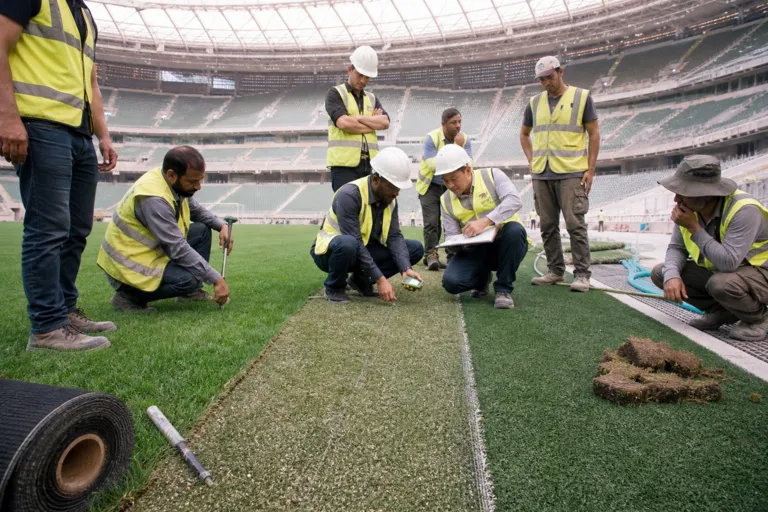
At the elite end, standards and test regimes shape procurement. A World Cup-focused explainer says FIFA Quality Pro certification for artificial football pitches requires passing 22 laboratory and field tests covering ball roll, vertical deformation, energy restitution, rotational resistance, and surface temperature. It lists example measurable thresholds: ball roll of 4–10 meters, vertical deformation of 4–9mm under a 46kg load, energy restitution of 55–70%, and rotational resistance of 25–50 Newton-meters. The same explainer describes modern 4th-generation turf systems using monofilament polyethylene fibers, typically 60mm in pile height, with infill that can include crumb rubber and organic options such as cork or coconut fiber. It also stresses that surface temperature is tested but “not capped by a hard limit.”
For hot-climate operators, materials innovation is part of the pitch conversation, but not a guarantee. One market analysis reports that a supplier introduced cooling fiber technology that reduced surface temperatures by 12 °C in hot climates and says it was used in 8% of new commercial lawns. The same analysis says stadium retrofits are moving too, with 15% of major arenas replacing natural grass with hybrid or full synthetic turf for durability and multi-event use. It also describes a hybrid approach where a retrofit used hybrid synthetic grids in 20% of field area to reduce maintenance demands and downtime. Other market commentary points to hybrid turf solutions and smart turf technologies with embedded sensors for usage and performance monitoring gaining traction in professional sports venues.
In the Gulf region, arid conditions and build-outs make water-saving surfaces a recurring theme, but adoption varies by use case. A market report states that about 44% of new urban landscaping in the Gulf region utilizes turf and adds that sports investments in Saudi Arabia and the UAE have fueled demand, with 33% of newly developed stadiums now using synthetic fields. Yet the same ecosystem faces constraints that procurement teams must price in. Another analysis warns that disposal of aged turf (with lifespan ~ 8–12 years) raises waste handling issues, noting that many fields produce tens of tons of synthetic waste and that recycling infrastructure exists only for 5–10% of decommissioned turf. For Saudi stadium planners weighing natural, hybrid, or synthetic, those tradeoffs shape the market behind the build.
What is pushing stadiums toward synthetic or hybrid pitches instead of natural grass?
What does FIFA Quality Pro certification test for artificial football pitches?
How fast is artificial turf demand growing globally?
What are the main challenges with synthetic turf at end of life?
What does the market data suggest about hybrid pitch turf technology in Saudi Arabia?