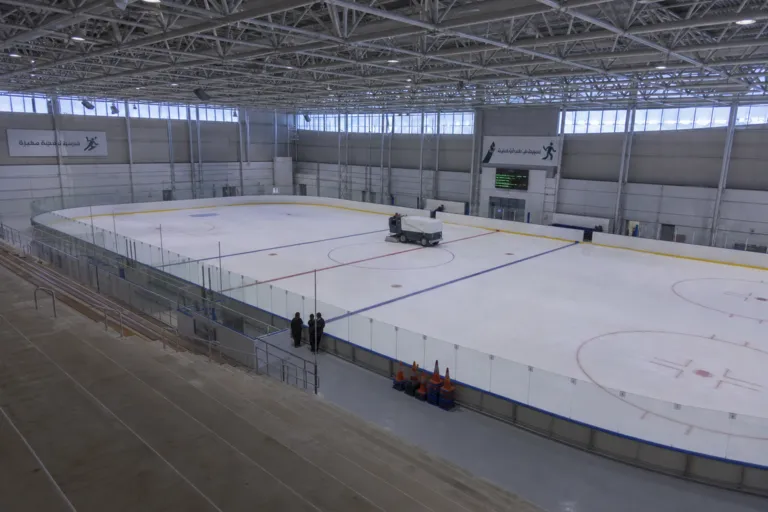
Ice rinks in a desert climate can look counterintuitive on paper. But the current momentum around winter sports in Saudi Arabia is being driven by policy, infrastructure, and consumer demand signals that investors can track. Ken Research reports that the Saudi government has invested over USD 1.5 billion in sports infrastructure, including ice rinks and training facilities, under Vision 2030. The same source links rink buildouts and youth programs to higher sport visibility and participation. For investors, that matters because venue-led participation is what turns a one-off attraction into repeatable footfall, programming revenue, and downstream demand for equipment and training.
Demand is also visible through adjacent market indicators and spending behavior. Ken Research values the Saudi Arabia ice hockey equipment market at approximately USD 165 million, and ties growth to increasing popularity and government initiatives. It also notes a 20% increase in consumer spending in the sports sector over the last year, alongside a projection that Saudi Arabia’s GDP per capita could reach USD 25,000 in the future. Those signals do not prove rink profitability by themselves, but they do suggest more households can allocate budget to paid leisure, lessons, and gear. That is the basic consumption base indoor rinks depend on, especially when pricing for equipment can be a barrier for new players.
From Proof-of-Concept Rinks to Scalable Indoor Models
Saudi Arabia already has tangible proof-of-concept for real-ice experiences. Ice Wonderland says it designed and delivered the first seasonal outdoor real-ice rink in the Eastern Province, as part of Global City Dammam, covering more than 900 m². Even as a seasonal format, that size signals the kind of visitor-scale activation developers look for when testing entertainment concepts. Yahoo Sports also reports planned indoor ski resorts in Riyadh and elsewhere, positioning year-round winter-sport environments as part of a broader pipeline. Together, these signals help investors frame site selection and timing: start where audiences already engage with experiential venues, then expand into more standardized indoor operations.
For operators thinking beyond natural ice, synthetic surfaces are a parallel pathway. Verified Market Reports values the Middle East & Africa synthetic ice skating rink market at USD 0.15 billion in 2024 and projects it to grow from USD 0.2 billion in 2025 to USD 0.35 billion by 2033, at a CAGR of approximately 7.8%. The same source notes that countries including Saudi Arabia are investing heavily in indoor entertainment complexes and sports facilities that incorporate synthetic ice to diversify leisure options and attract events. This gives developers flexibility on capex and operating models while still monetizing skating, learn-to-skate programs, and event-driven footfall.
A practical way to think about ice rink investment in Saudi Arabia is to compare how quickly new sports infrastructure can scale when demand is proven. Padelnomics tracks 36 padel venues across 7 Saudi cities, counting 159 courts at venues with known court numbers. With a population of 37.0 million, it calculates 0.4 padel courts and 0.1 venues per 100,000 residents, and reports an average Padelnomics Score of 87/100 across tracked cities. The lesson is not that ice will mirror padel, but that emerging-sport supply gaps can persist even while adoption accelerates in key cities. For rink investors, the near-term edge comes from pairing venues with training pathways, leagues, and repeat programming rather than relying only on novelty visits.
What supports the investment case for indoor ice venues in Saudi Arabia?
Is there evidence of real-ice rink demand in Saudi Arabia today?
How does synthetic ice change the economics for venue developers in the region?
How can investors gauge where to place an ice rink investment in Saudi Arabia?