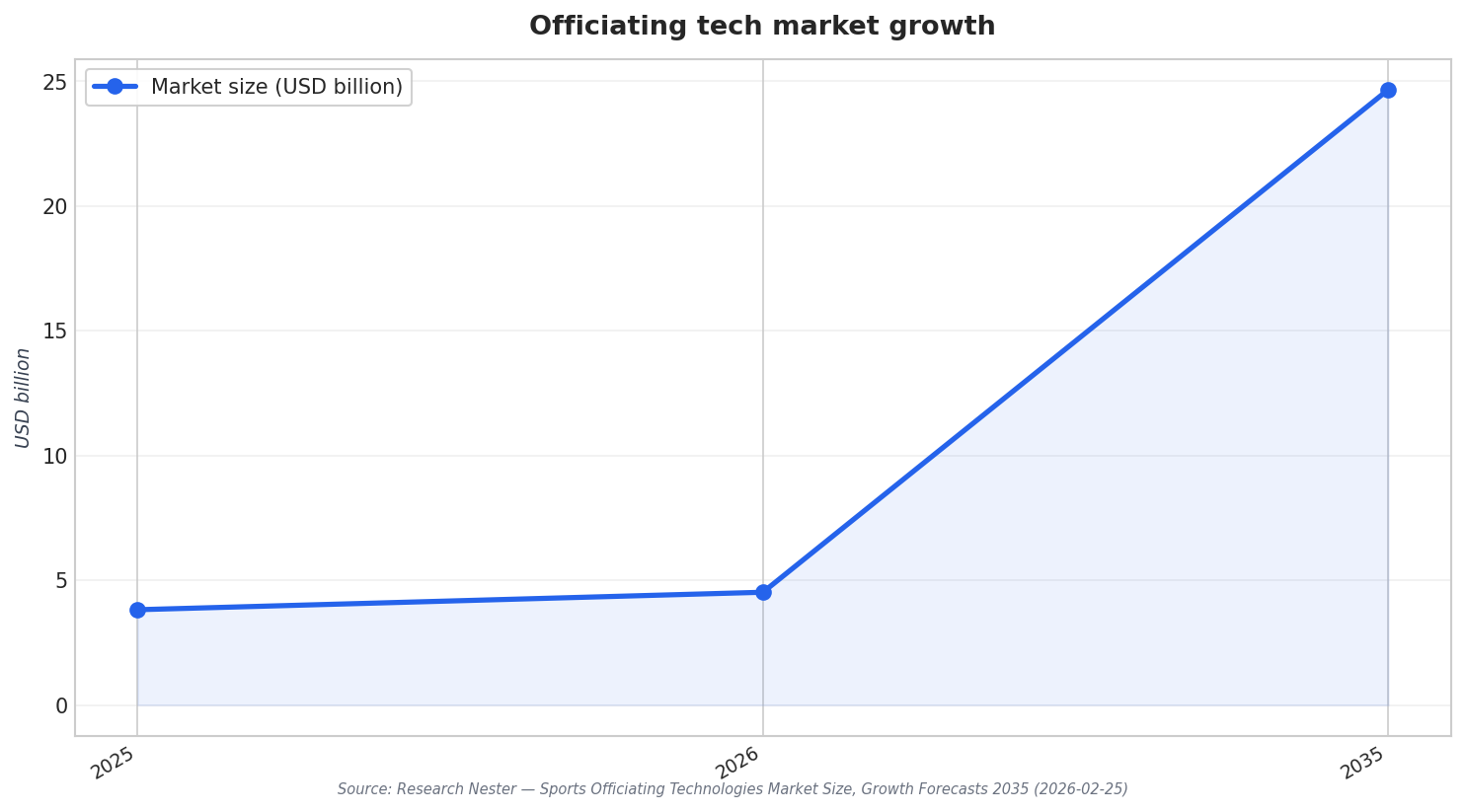
VAR and goal-line style systems sit inside a wider sports officiating technology market that is expanding fast. Research Nester values the sports officiating technologies market at USD 3.82 billion in 2025, estimates USD 4.52 billion in 2026, and says it is set to exceed USD 24.66 billion by 2035 with over 20.5% CAGR (2026–2035). Future Market Insights similarly estimates USD 3.8 billion in 2025 and projects USD 23.4 billion by 2035 at 20.0% CAGR. These are global figures, not Saudi-specific. But they explain why vendor competition and long-term support models matter when a top league like the Saudi Pro League deploys video review and goal-line decision tools across matchdays.
In football, vendors sell more than cameras. They sell workflows that help officials reach review-ready decisions faster and more consistently, and they must integrate with broadcasters and stadium operations. Fact.MR frames this shift as leagues moving from tournament use toward season-long contracts, and it forecasts the AI sports officiating market rising from USD 0.6 billion in 2026 to USD 5.6 billion by 2036 at 25.0% CAGR (global). It also describes why football buyers are moving from manual offside line drawing toward camera and ball tracking that produces a review-ready decision. These global dynamics are relevant context when discussing VAR officiating technology in the Saudi Pro League, because procurement choices tend to favor systems that scale across full seasons and multiple venues.
How the Vendor Market Competes: Contracts, Installs, and Integration
The vendor battleground is often decided by deployment and revenue models, not just technical specs. Fact.MR says venue-installed systems are forecast to secure 42.0% share in 2026 (global), reflecting permanent camera calibration requirements for top stadiums. It also says multi-year contracts are anticipated to contribute 44.0% of total revenue in 2026 (global), and professional leagues are likely to represent 48.0% of the market in 2026. In practice, this points to vendors competing on installation capability, certification processes, ongoing maintenance, and operator training. Market Research Future adds that as leagues adopt VAR, demand for training and support systems for officials is likely to grow, and it emphasizes user-friendly interfaces and seamless integration with existing systems.
Technology mix also shapes who wins deals. Future Market Insights lists video-based solutions as the leading segment in 2025 at 34.0% (global), matching the reality that VAR is a video-centric workflow. Credence Research segments the market into video assistant systems, goal-line and sensor-based tracking, wearable monitoring devices, timekeeping tools, and AI-enabled decision support platforms, and states that video review systems and VAR dominate due to widespread adoption in global tournaments and professional leagues. Vendors position around these stacks, offering multi-angle camera systems, slow-motion replay, and tracking options that can feed officials, scoreboards, and broadcasters without creating separate data workflows, echoing Fact.MR’s point about certified systems and integrated outputs.
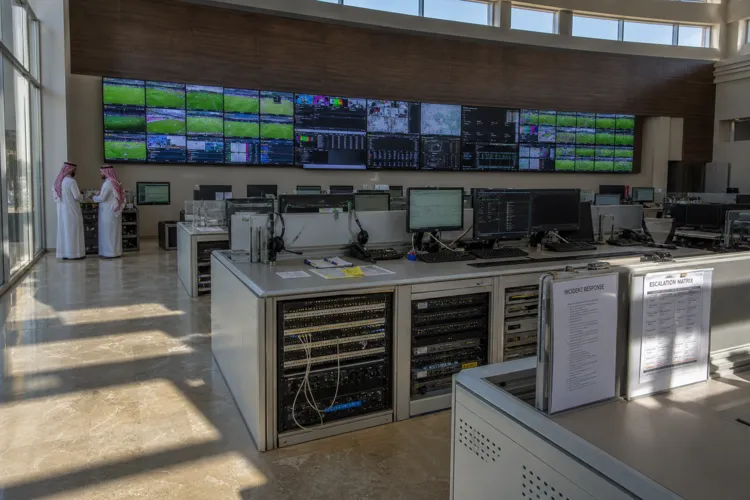
Credibility is the core product. Research Nester cites a July 2020 paper in the Journal of Sports Sciences that measured a 92.1% to 98.3% increase in accuracy while using VAR, and it ties adoption to the push for fair decision-making and reduced human error. This is global evidence, not a Saudi Pro League statistic, but it clarifies why leagues invest even when implementation is complex. Vendor selection therefore extends beyond hardware to the “explainability” layer, since, as Fact.MR’s analyst notes, buyers ask where the ball was, which body point mattered, and whether the system can explain the call to fans in seconds. That expectation shapes how vendors package VAR rooms, communication tools, and on-screen broadcast integrations.
How does VAR officiating technology in the Saudi Pro League connect to the global vendor market?
What market growth signals are pushing more investment into officiating technology?
Why do vendors emphasize venue-installed systems for top football stadiums?
Which technology segment leads in officiating systems, and why does that matter for VAR?
What accuracy evidence is cited for VAR, and how should it be interpreted?