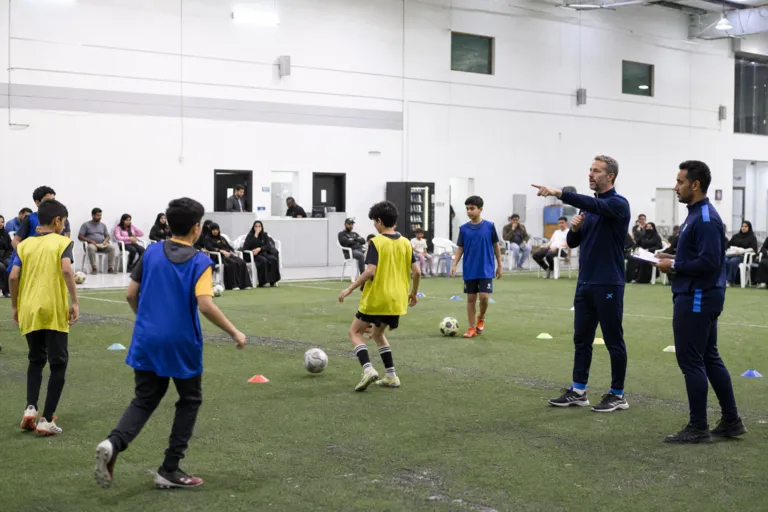
European football academy partnerships are becoming a visible part of Saudi Arabia’s youth-development strategy. A January 2026 report describes a long-term approach that brings European clubs and staff into the Kingdom to build local talent and deepen ties with global football brands. Juventus has opened three academies in Saudi Arabia, located in Al-Khobar, Jeddah, and Riyadh. Paris Saint-Germain is also present, with two academies in Jeddah, one in Riyadh, and one in Dammam, and Liverpool is listed among the clubs operating academy activity. The same report notes that Inter opened its academy in December 2024 and AC Milan followed about a year later, with both choosing Jeddah, which it describes as a main center of Saudi grassroots football.
The operational model behind these licensed academies shows how the “badge” can be localized while keeping European methods. Juventus Academy in Al-Khobar is described as financed and managed by Al-Shoaibi Group, a Saudi holding founded in 1971 by Suhayl Al Shoaibi. Juventus is responsible for training the technical staff, and the coaches are described as holding UK UEFA certificates. The report names staff including Portuguese coach Cristiano Neto, also an assistant manager at Al-Qadsiah Under-16, and Zuber Patel, a former technical director of Blackburn Rovers women’s youth academy. Entry is described as starting at age 4, with players staying until 18, and programs are mentioned for both boys and girls, including a “Superior Striker Project” focused on attacking expertise.
Why Saudi Market Conditions Make Academy Licensing Easier to Scale
Scaling academy participation depends on families being able to find, evaluate, and pay for structured programs. In Saudi Arabia’s e-commerce market, Mordor Intelligence estimates market size at USD 31.29 billion in 2026, up from USD 27.96 billion in 2025, with a projection of USD 54.87 billion by 2031 at an 11.92% CAGR over 2026–2031. The same source cites 99% internet penetration and 78% 5G coverage, supporting an always-connected consumer base. It also reports smartphones delivered 77.98% of B2C e-commerce revenue share in 2025, and credit/debit cards held a 42.62% share of B2C payments, while digital wallets are projected to grow at a 14.71% CAGR to 2031. For branded academies, these conditions can support mobile-first sign-ups, renewals, and communications without assuming any single club’s specific tech stack.
Demand for organized training also sits alongside a broader shift toward paid fitness services. Mordor Intelligence estimates the Saudi Arabia health and fitness club market at USD 1.74 billion in 2026, up from USD 1.56 billion in 2025, with USD 3.01 billion projected by 2031 at an 11.53% CAGR over 2026–2031. In 2025, membership fees accounted for 79.74% of revenue, and personal training and instruction is projected to advance at a 12.95% CAGR through 2031. Men accounted for 77.62% of participation in 2025, while women are described as the fastest growing cohort at a 13.05% CAGR to 2031. The academy report also highlights boys’ and girls’ programs, aligning with a wider market story in which structured instruction is expanding, even as participation patterns differ by segment.
Finally, place-making matters, because academies need fields, facilities, and accessible neighborhoods. Mordor Intelligence values Saudi Arabia’s real estate market at USD 72.84 billion in 2026 and projects USD 102.96 billion by 2031 at a 7.17% CAGR. It also cites a combined USD 1.3 trillion allocation for NEOM, Red Sea, Diriyah, Qiddiya, and New Murabba, described as driving demand across housing, hospitality, retail, and offices well past 2040. NEOM alone is described as targeting 1.5 million residents by 2030, translating into 500,000 homes and 10 million m² of commercial space. Separately, Saudi Arabia’s construction market is valued at USD 142.30 billion in 2026, rising to USD 186.13 billion by 2031 at a 5.52% CAGR, with infrastructure holding 36.6% share in 2025. Together, these figures provide context for why licensed academies cluster in cities like Jeddah, Riyadh, Dammam, and Al-Khobar, where development and demand concentrate.
Which European clubs are named as running academies in Saudi Arabia?
Where are Juventus Academy locations mentioned in Saudi Arabia?
What age range can join the Juventus Academy programs described in the sources?
How do European football academy partnerships connect to Saudi Arabia’s digital purchasing habits?
What market signals suggest sustained demand for paid training and facilities in Saudi Arabia?