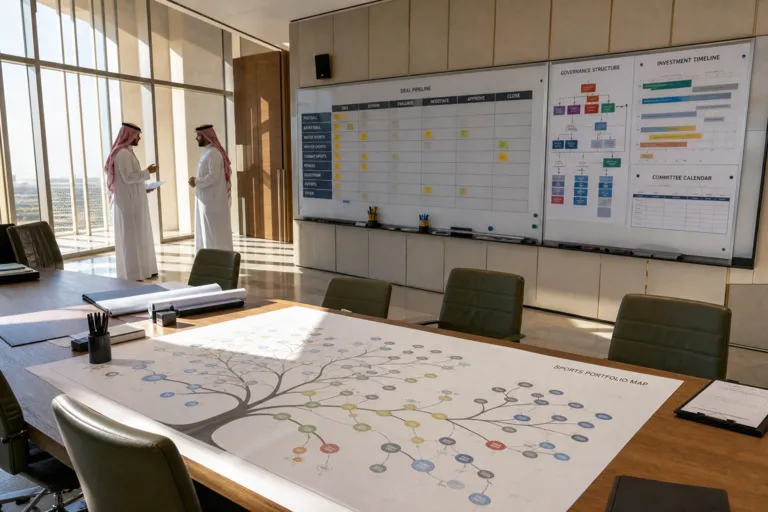
Saudi Arabia’s Public Investment Fund sits at the center of Vision 2030, operating as both a long-horizon investor and a state development vehicle. At year-end 2024, it had assets under management of approximately USD 1.21 trillion, described as USD 913 billion officially and +19% year-over-year, and it was approximately USD 1.15 trillion by mid-2025. Governance is concentrated at the top of the Saudi state: Crown Prince Mohammed bin Salman chairs the board, while Governor Yasir Al-Rumayyan executes day-to-day strategy and also chairs Newcastle United and Savvy Games Group. This structure matters because the fund’s sports activity is not isolated; it connects to domestic entertainment infrastructure, portfolio performance, and how capital is redeployed inside the Kingdom.
Within the PIF sports portfolio, football is the most visible global platform. The fund acquired Newcastle United in October 2021 for approximately £305 million (USD 375 million), structured through a consortium in which PIF held an 80% stake while PCP Capital Partners and RB Sports & Media each held 10%. Another source describes the Newcastle purchase as approximately USD 410 million in 2021, highlighting how figures can differ in public reporting. By July 2024, PIF lifted its stake to 85%, with RB Sports & Media holding the remaining 15%. The Premier League approved the takeover after receiving legally binding assurances that the Kingdom of Saudi Arabia would not control or direct the club’s operations, a key point in understanding how regulatory constraints shape deal design.
How PIF Uses Diversification Across Sports and Entertainment
PIF’s sports exposure is deliberately diversified across football, golf, combat sports, tennis, motorsport, and esports, with an emphasis on building a broader ecosystem around events, venues, broadcasting, and sponsorship. One analysis describes PIF’s sports-related investments as exceeding USD 6 billion in direct capital deployment, while also arguing that indirect economic activity pushes the total higher without assigning a precise figure. On the domestic participation side, Vision 2030 targets increasing regular physical activity from 13% to 40% by 2030, tying elite events to quality-of-life goals. Saudi Arabia also hosts the annual Dakar Rally, Formula E races, and WTA tennis events, positioning the calendar as multi-discipline rather than a single-league strategy.
Esports and gaming add a demographic and demand layer that complements stadium-led projects. Saudi Arabia is described as having over 23 million gamers, and 67% of the population is under age 35, framing why Savvy Games Group and related investments are treated as strategic. Savvy’s investments include stakes in Nintendo, Activision Blizzard (prior to the Microsoft acquisition), and Electronic Arts, alongside full acquisitions of game development studios. Infrastructure development reinforces the portfolio logic: Qiddiya, a PIF-backed entertainment gigaproject near Riyadh, is planned to include a 45,000-seat stadium, motorsport facilities including a Formula 1-grade circuit, water sports venues, and an extreme sports complex. In parallel, PIF’s published 2026–2030 strategy is described as shifting from rapid growth toward value realization, portfolio performance, long-term returns, and active management of strategic assets.
Recent transactions underline that sports assets can be actively managed rather than held indefinitely. In April 2026, PIF and Kingdom Holding Company (KHC) signed an agreement for KHC to acquire 70% of Al-Hilal Club Company, and the move was framed as aligned with maximizing returns and redeploying capital within the Saudi economy. That language echoes the fund’s 2026–2030 emphasis on performance and cost-efficient operations. At the same time, public reporting and analysis note that sports investments are inherently public and can face contested structures, funding questions, and scrutiny around governance. The strategic takeaway is that PIF’s sports footprint is built to serve multiple objectives at once, but it is still expected to fit capital-efficiency and return logic as the fund’s approach matures.
What does the PIF sports portfolio include beyond football?
How much did PIF pay to acquire Newcastle United, and what stake does it hold now?
How large are PIF’s sports-related investments according to the sources?
Why are esports and gaming part of Saudi Arabia’s sports investment strategy?
What does the Al-Hilal transaction suggest about PIF’s approach in 2026–2030?