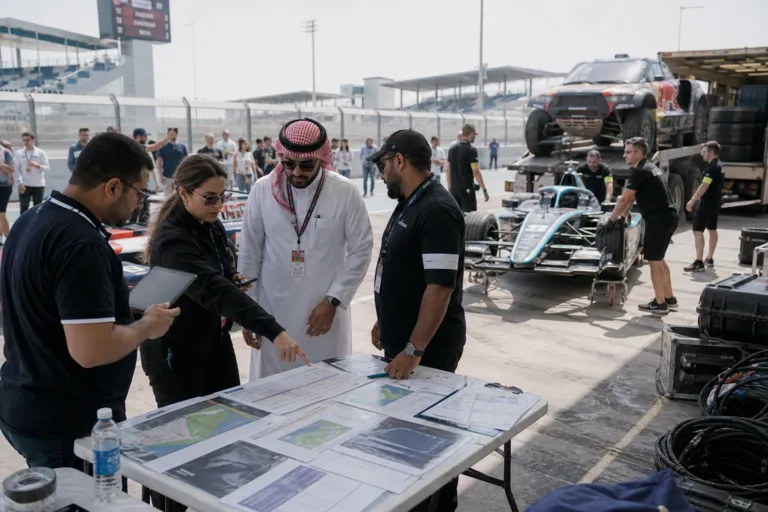
Motorsports Saudi Arabia has become a recognizable thread in the Kingdom’s broader sports push. The Dakar Rally, a multiday off-road endurance event, has been held in Saudi Arabia since 2020. The Saudi Arabian Grand Prix joined the Formula 1 calendar in 2021. In 2026, Formula 1 confirmed the Bahrain and Saudi Arabian Grands Prix would not take place in April, citing the ongoing situation in the Middle East region and noting the decision was taken in full consultation with the FIA and promoters. Those calendar changes underline that motorsport schedules can move, even when long-term plans remain in place.
The Kingdom’s F1 story is also tied to future infrastructure. Reporting notes the race is not expected to stay in Jeddah, with another track being built in Qiddiya as part of Vision 2030, with a view to staging races there from 2028 or 2029. The Qiddiya Speed Park Track is being developed by the Qiddiya Investment Company, which is owned by PIF. It has been designed by circuit designer Hermann Tilke and ex-F1 driver Alexander Wurz. A standout design detail is a 20-story-high corner, a feature that signals a made-for-television approach to track development.
Formula E Partnerships and the Investor Lens
Beyond Formula 1, PIF is described as more heavily invested in other motorsport categories through partnerships. In 2024, the fund announced the creation of the Electric 360 partnership with Formula E, Extreme E (now Extreme H) and E1, which is a powerboat racing series. The intent is not expressed as a single event, but as a connected ecosystem of properties. In parallel, Saudi Arabia’s historical ties to F1 date to the 1970s via business sponsorships, including Airline Saudia sponsoring Williams from the late 1970s until the end of the 1984 season, a period that included the team’s first two constructors’ championships.
Specific investment moves show how capital has flowed in and out of motorsport-related assets. In 2021, PIF and Ares Management reportedly invested £400 million in the McLaren Group, and the stake was eventually sold to Bahrain’s state investment fund, Mumtalakat, a few years later. Separately, Aramco became heavily involved in Formula 1 through its Formula One Management and Aston Martin partnerships. Aramco is majority-owned by the Saudi Arabian government, and PIF held 16 percent as of 2025. These details matter because they show both direct equity-style exposure and commercial partnership exposure inside the same sport.
Investor returns are now a more explicit theme across Saudi sports strategy, and motorsport sits inside that context. A new prospectus for PIF’s 2026–30 strategy focuses on more internal investment while “maximizing financial returns, strengthening investment efficiency and increasing private sector participation.” Business reporting also cited a five-year strategic plan approved by MBS that prioritized efforts to “maximize returns and redeploy capital within the domestic economy.” In that wider sports economy, one projection puts the Saudi sports market at $22.4 billion by 2030, up from $1.3 billion in 2016, alongside $2.7 billion committed to facility development by 2028. The motorsports calendar, the Qiddiya build, and the Electric 360 portfolio can all be read through this same returns-and-domestic-focus lens.
What does “motorsports Saudi Arabia” include in the current calendar?
Why was the 2026 Saudi Arabian Grand Prix not scheduled for April?
What is planned for F1 hosting beyond Jeddah?
What is the Electric 360 partnership and which series does it cover?
How is Saudi Arabia framing investor returns in sports going forward?