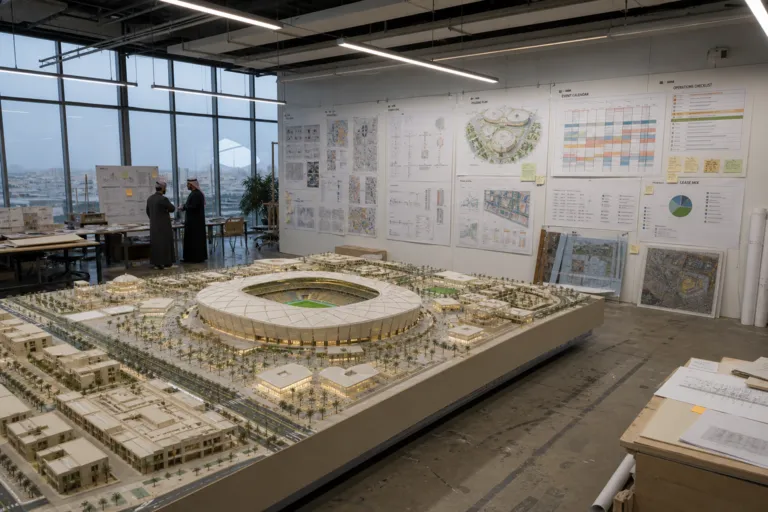
Saudi football is being positioned as a connected economic system, not just a national-team story. One analysis links the Saudi Arabia national team, the Saudi Pro League, PIF-backed club ownership, stadium construction, FIFA World Cup 2034 preparation, tourism, broadcast reach, and soft power into a single platform. The Saudi Pro League describes itself as the governing body of the country’s top-tier competition, with 18 clubs and a transformation strategy launched in early 2023 aligned with Vision 2030. That strategy is framed around talent development, international players, club governance, fan engagement, commercial growth, and economic and social impact, which makes stadium control a governance and commercial lever, not a side project.
The business case for club ownership gets sharper when you look at utilization risk. Roland Berger notes that Saudi Pro League stadium utilization rates have lagged well behind comparable leagues, and that Riyadh may face a potential oversupply of large venue capacity relative to its resident population by 2034. That warning matters because new builds and upgrades are already moving. A venue management report states that construction on 15 new smart stadiums is underway, and it also describes the NEOM Stadium proposal as a 46,000-capacity stadium planned 350 metres above the ground, with work set to begin in 2027 and conclude in 2032. In that context, clubs benefit when they can design for their own demand, share calendars with other events, and avoid being one of many tenants competing for the same dates.
Where Club Ownership Wins: Calendar, Ops, and District Value
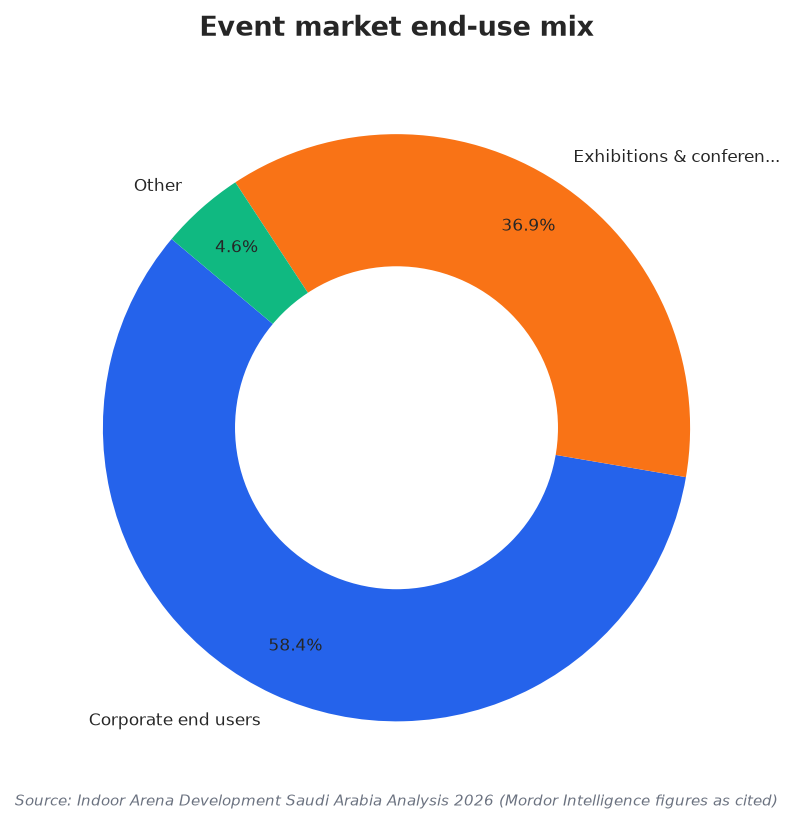
Club-owned stadium development Saudi Arabia strategies increasingly hinge on programming density and professional operations. Indoor arena analysis argues that year-round programming needs year-round buildings, and ties that to expanding paid entertainment. Saudi Arabia’s entertainment and amusement market is estimated at USD 2.98 billion in 2026, up from USD 2.65 billion in 2025, with projections of USD 5.36 billion by 2031 at a 12.4% CAGR over 2026–2031. The same source projects the Saudi event management market rising from USD 2.59 billion in 2025 to USD 2.77 billion in 2026 and reaching USD 3.92 billion by 2031 at a 7.14% CAGR. Utilization indicators in 2025 also show average venue utilization at 68% in Riyadh and 61% in Jeddah, pointing clubs toward designs that support concerts, sports, exhibitions, and family formats alongside football.
Operations and maintenance are another reason ownership can pay off, because the Saudi market already buys performance-driven services at scale. Mordor Intelligence projects the Saudi Arabia facility management market at USD 51.66 billion in 2025 and USD 54.56 billion in 2026, reaching USD 78.46 billion by 2031, with 7.54% CAGR from 2026 to 2031. Outsourced delivery accounted for 59.36% of market size in 2025 and is projected to grow at an 8.34% CAGR to 2031, while hard services held 54.59% share in 2025 and soft services are forecast to grow at 8.12% CAGR through 2031. Mordor also cites predictive maintenance and energy analytics cutting unplanned downtime by up to 70%, with field tests showing maintenance costs reduced by 25–30% and breakdowns lowered by up to 75%. For clubs, that supports a model where venue uptime, matchday readiness, and non-match events become managed outcomes, not hopes.
The final layer is real estate value capture, where the venue becomes the magnet and the district becomes the annuity. A sports-anchored real estate explainer cites Colliers estimates in the United States, including Washington D.C. spending an estimated $3.8 billion on a new 65,000 seat stadium with mixed-use development across 180 acres, and notes that nearly 40 similar projects are in the works across the US. Colliers also cites a $332 million mixed-use development linked to FC Cincinnati and an adjacent $34 million townhome initiative near TQL Stadium that includes 69 townhomes, with six income-restricted units. These are not Saudi figures, but they illustrate the mechanism Roland Berger highlights: capturing value through a surrounding masterplan to keep the stadium financially viable. With scrutiny increasing on post-event performance, club-led districts can connect stadium economics to everyday spending instead of relying on occasional headline matches.
Why does club ownership matter for stadium strategy in Saudi Arabia?
What utilization risk is flagged for Riyadh by 2034?
What is known about the NEOM Stadium proposal in the sources?
How does outsourcing support club-run stadium operations in Saudi Arabia?
What does the international mixed-use playbook suggest for Saudi club stadium districts?