Padel Saudi Arabia sits inside a broader national push to use sport as both a growth engine and a tool for domestic development. Multiple sources describe a shift toward “maximizing financial returns,” “strengthening investment efficiency,” and increasing private sector participation, with a 2026-30 strategy emphasizing more internal investment. That context matters for padel decisions because court projects are capital-heavy, while utilisation and pricing decide whether the asset can stand on its own. For operators, the lesson is simple. Build a model that can work even when funding is more disciplined, and align the venue with domestic spending and local community demand.
Court investment starts with the physical build and the indoor-versus-outdoor choice. One UK source states that installing two courts can cost around £75,000, and that covering them, if needed, can easily double the bill. The same source notes that some commercial units on industrial estates are being fitted with “eight or nine courts,” implying that scale is often used to spread overhead and staffing across more bookable hours. For Saudi developers and landlords, the comparable decision is whether to prioritise lower-cost outdoor builds, or to pay more to control the playing environment. In both cases, capex should be mapped to a realistic pricing plan.
Operating Models: Own-Operate vs Partnered Rollouts
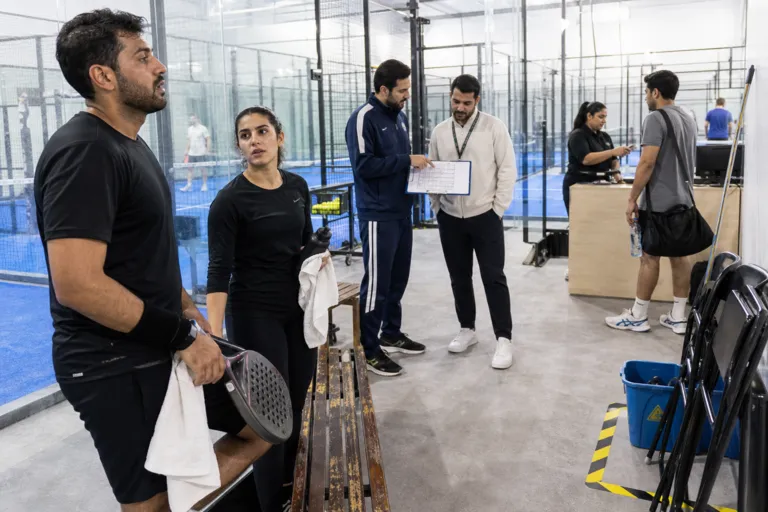
Operating models generally fall into two buckets: run the courts yourself, or partner with a specialist. The sources highlight that providers can offer a hybrid option where the company pays for building the courts, provides a booking system, and in return takes a percentage of court fees. That shifts upfront cost away from the site owner, but it also shares revenue. Another path is in-house operation. A case study describes an estate planning to run a two-court facility in-house rather than lease, positioning it as “placemaking” for the local community. For padel Saudi Arabia, both models can work, but the best fit depends on capital appetite, operational skill, and how quickly the venue needs to open.
Membership economics in padel often comes down to affordability, repeat play, and retention, even when sales are framed as simple hourly bookings. The sources show wide dispersion in court pricing. One operator cites London courts that can reach £100 per hour, while its own average charge is about £30 per hour, describing an “affordable for everybody” approach that keeps courts busy. Separately, Playtomic data cited by the Financial Times puts London’s average cost at €59 per hour. These numbers are not Saudi-specific, but they illustrate the core economic lever: price influences utilisation, and utilisation supports stable cash flow. In a membership-style model, the goal is to turn busy calendars into predictable renewal behaviour.
Finally, padel venues in Saudi Arabia can benefit from being integrated into mixed-use and hospitality strategies rather than standing alone. A Saudi hospitality portfolio referenced in the sources totals USD3.6 billion and aims to deliver more than 3,300 hotel units from 2025 to 2038, using flexible models including public-private partnerships, investment funds, and joint ventures. Those structures mirror how sports facilities can be financed and operated. At the same time, major Saudi sports initiatives underscore the country’s willingness to fund marquee events, such as a WTA Finals deal from 2024 to 2026 offering more than $15 million per year in prize money. For padel, the practical takeaway is to design venues that can plug into destination footfall, partnerships, and disciplined, return-focused capital.
What does “padel Saudi Arabia” investment need to prioritize right now?
What court build cost figures are available in the sources?
What operating models are mentioned for padel courts?
What pricing benchmarks do the sources show for padel court fees?
How does Saudi Arabia’s broader sports spending relate to padel economics?