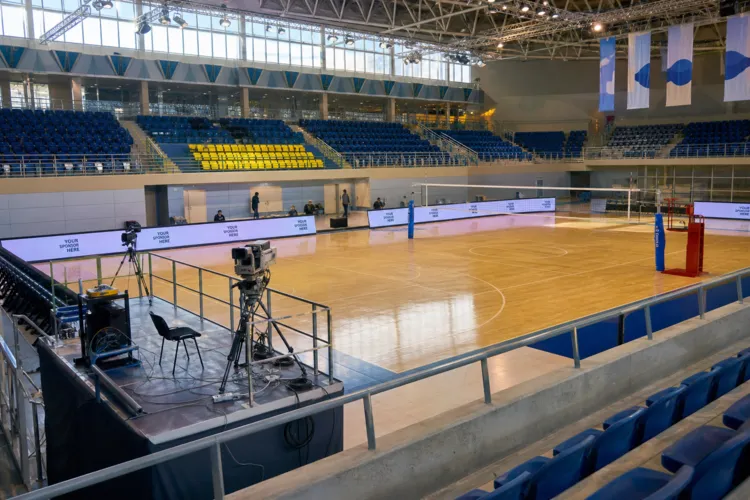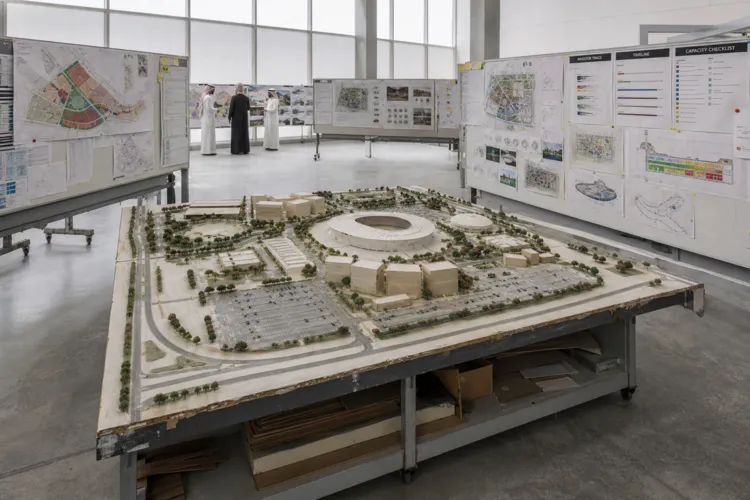
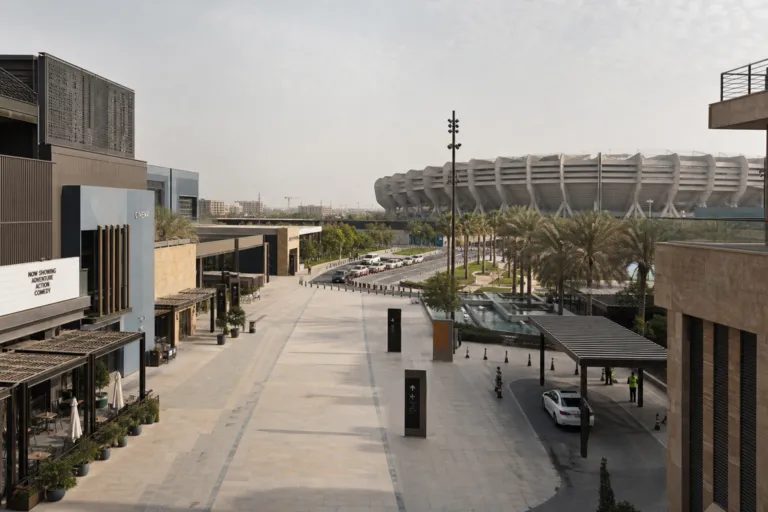
Sports venues increasingly act as city-building infrastructure, not isolated buildings surrounded by parking. Multiple sources describe the same shift: stadiums and arenas now anchor “experience districts” that combine retail, hospitality, offices, and housing to create activity beyond game days. For stakeholders thinking about sports-anchored real estate in Saudi Arabia, the key takeaway is structural rather than local-by-default: the venue becomes the magnet, while the surrounding real estate captures repeat visits and everyday spending. Stratford Analytics notes that stadium development frequently sparks complementary projects such as hotels, restaurants, entertainment districts, and mixed-use developments that leverage the venue’s drawing power.
That real estate logic shows up in how planners and designers frame outcomes. HKS writes that stadiums now power “vibrant, walkable neighborhoods” intended to deliver year-round value, and adds that mixed-use developments outperform single-use properties in value growth. HKS also cites a specific urban-performance link: a 10-point increase in a property’s Walk Score is associated with an estimated 5–8% increase in commercial value. For investors, this connects design choices—connectivity, public realm, and adjacency—to potential financial outcomes, even before counting event-day revenue.
What Mixed-Use Programming Looks Like When the Stadium Is the Anchor
Urban Land provides a concrete example in Ohio: Brook Park, planned for delivery alongside a new Cleveland Browns stadium in 2029, is described as a 176 acre (70 ha) mixed-use community. It ultimately includes 300,000 square feet (27,870 sq m) of retail, two upscale hotels, 1,100 apartments, and 500,000 square feet (46,450 sq m) of office space. Phase one—planned for delivery alongside the stadium in 2029—includes approximately 300 hotel rooms, 500 apartments, and 190,000 square feet (57,912 sq m) of traditional and experiential retail intended to drive year-round activation. This kind of stack is designed to create a daily ROI, not just an event-driven spike.
U.S. deal and pipeline signals reinforce the momentum, while also reminding readers to keep geography explicit. Colliers reports Washington D.C. is estimated to spend $3.8 billion on a new 65,000 seat stadium along with mixed-use development across 180 acres, and says nearly 40 similar projects are in the works across the United States. In Cincinnati, Colliers cites a $332 million mixed-use development linked to FC Cincinnati and notes an adjacent $34 million townhome initiative near TQL Stadium that includes 69 townhomes, with six income-restricted units. These examples show how a stadium can pull in both large master plans and smaller follow-on projects next door.
Capital and tenant demand are also reshaping the model. KeyCrew highlights the influx of private equity into sports-adjacent real estate and describes why: mixed-use districts provide diverse revenue streams that help offset the rising costs of building and renovating venues. Sports Business Journal adds a forward-looking benchmark from JLL: entertainment districts anchored by major venues are predicted to grow to represent 30% of national office inventory by 2040, compared to 4% now (a U.S.-scoped projection). For anyone evaluating sports-anchored real estate Saudi Arabia strategies, the transferable lesson is to underwrite the district as a portfolio—hospitality, retail, residential, and office—so the venue’s draw supports multiple lines of return year-round.
What is a sports-anchored mixed-use district, and why does it matter for returns?
What specific programming elements are used to create year-round value?
What performance signals support walkable, mixed-use planning around venues?
How much investment and scale do U.S. stadium-anchored projects show (as context)?
What does this imply for sports-anchored real estate planning in Saudi Arabia?