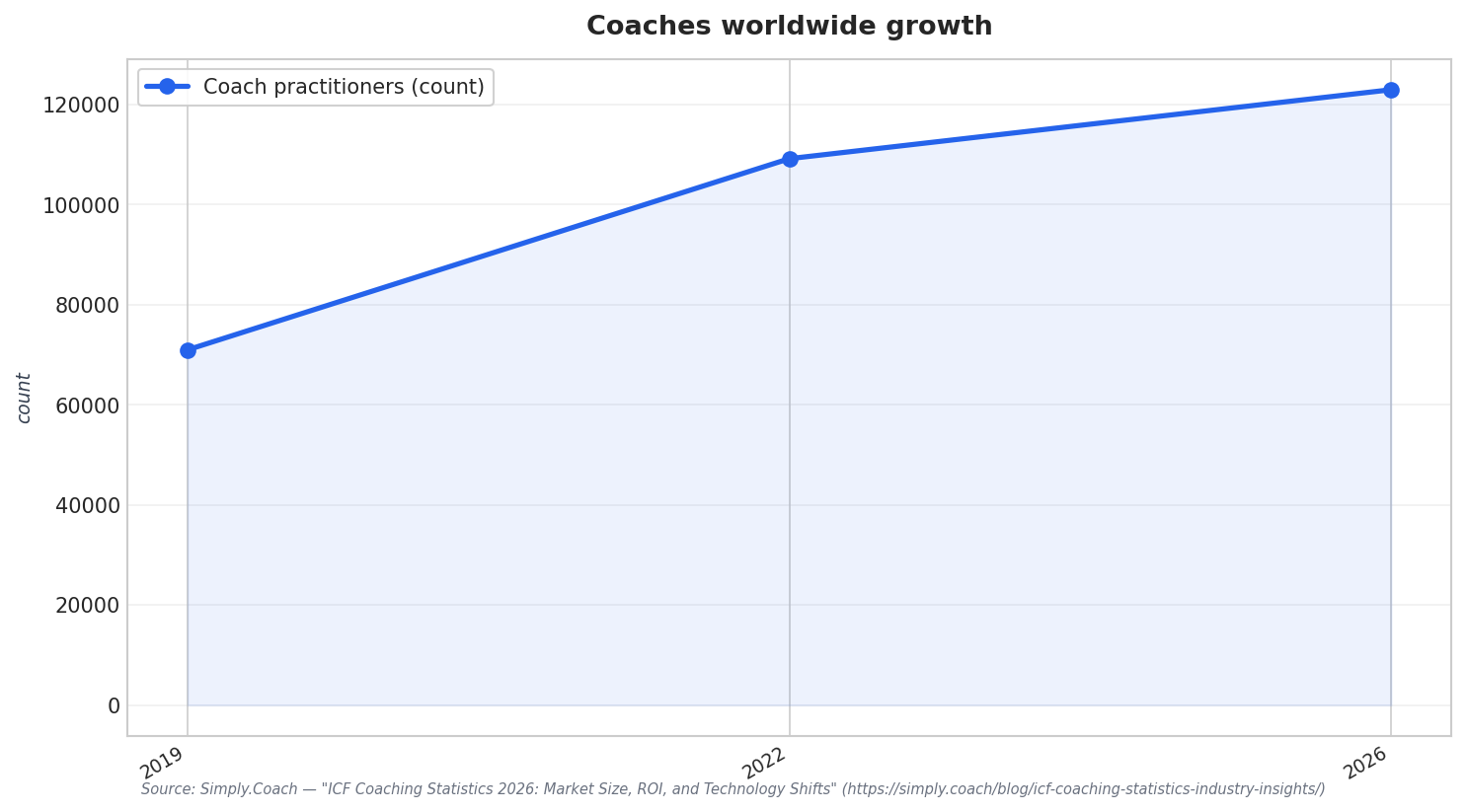
Interest in formal credentials is rising as coaching becomes more closely tied to measurable outcomes and institutional buying. Globally, the coaching industry is valued at USD 5.34 billion in 2026, based on ICF-reported insights summarized by Simply.Coach. The same source cites 122,974 coach practitioners globally in 2026 and notes that 87% of organizations report a positive ROI from coaching, linking gains to productivity, retention, and goal achievement. For international certification bodies looking at Saudi Arabia, these global signals matter because they push employers and learners toward credentials they can trust, compare, and procure at scale.
In Saudi Arabia, the adjacent market structures that typically feed a coaching licensure pipeline are already sizable and organized. Ken Research values the Saudi Arabia Executive Education and Upskilling Market at USD 2.3 billion, and describes growth drivers such as demand for skilled professionals and government initiatives aimed at enhancing workforce capabilities. The same source highlights the role of Riyadh, Jeddah, and Dammam as demand centers due to concentrations of corporate headquarters, government agencies, and specialized industry needs. This is where international certification bodies can position accreditation as a premium layer inside existing executive education, certification programs, and executive coaching offerings.
Where International Certification Bodies Can Win in Saudi Arabia
International standards can be a market-maker when buyers worry about quality variance. Verified Market Reports notes that an absence of universally recognized certification standards for career coaches can reduce market credibility and make it harder for clients to assess competence, especially amid unregulated online platforms. The same source points to industry bodies such as ICF and EMCC working toward standardization, while adoption remains inconsistent. That gap is a practical opportunity in the coaching certification market Saudi Arabia is building: certification bodies can offer clearer competency frameworks, auditable assessment, and credential pathways that procurement teams and institutional clients can understand.
Saudi policy and learning delivery formats also point to partnership-ready routes. Ken Research states that in 2023 the Saudi government implemented the National Strategy for Digital Transformation, a binding instrument issued by the Ministry of Communications and Information Technology, with compliance requirements for public and private sector entities to integrate digital skills and continuous learning into workforce development plans. On the supply side, Ken Research segments Saudi executive education and upskilling into online courses, blended learning, corporate training solutions, executive coaching, and certification programs, among others. International bodies can align their credential structures to these formats, especially hybrid and online delivery, to fit employer workflows.
Digital distribution and specialization strengthen the business case for credentialing. MarketResearch.com (Ken Research) states the digital learning market in Saudi Arabia is expected to reach SAR 2 billion (USD 533 million) in the future, and cites internet penetration at 99% as a driver. In parallel, Mordor Intelligence reports the global sports coaching market is expected to grow from USD 8.18 billion in 2025 to USD 8.89 billion in 2026, reaching USD 13.47 billion by 2031, and adds that the Middle East advances at a 9.44% CAGR in that market. For certification bodies, this combination supports credential offerings that plug into online platforms, emphasize assessment integrity, and expand into niches where demand is professionalizing.
What signals suggest Saudi Arabia is becoming attractive for coaching credential providers?
How can international certification bodies reduce buyer skepticism in career coaching?
Which Saudi cities are most relevant for partnerships in executive learning and coaching?
How does digital learning shape the coaching certification opportunity in Saudi Arabia?
What should stakeholders understand about the coaching certification market in Saudi Arabia today?