Winning work in Riyadh is no longer just about spotting an opportunity early. The Saudi Arabia Projects Market Report 2026 describes a market that remains the largest projects market in MENA, with a total project pipeline valued at USD 2.14tn, including USD 1.72tn that is planned and unawarded. It also notes a shift in how clients buy: developers are placing greater emphasis on cost, capacity, procurement strategy, and delivery risk. Even with USD 75.5bn in project awards recorded during the first eight months of 2026, the number of projects awarded fell, and there is increasing focus on awarding projects that are larger in value. For training assets linked to 2034 readiness, this means prequalification strength, delivery credibility, and resourcing plans can be as decisive as price.
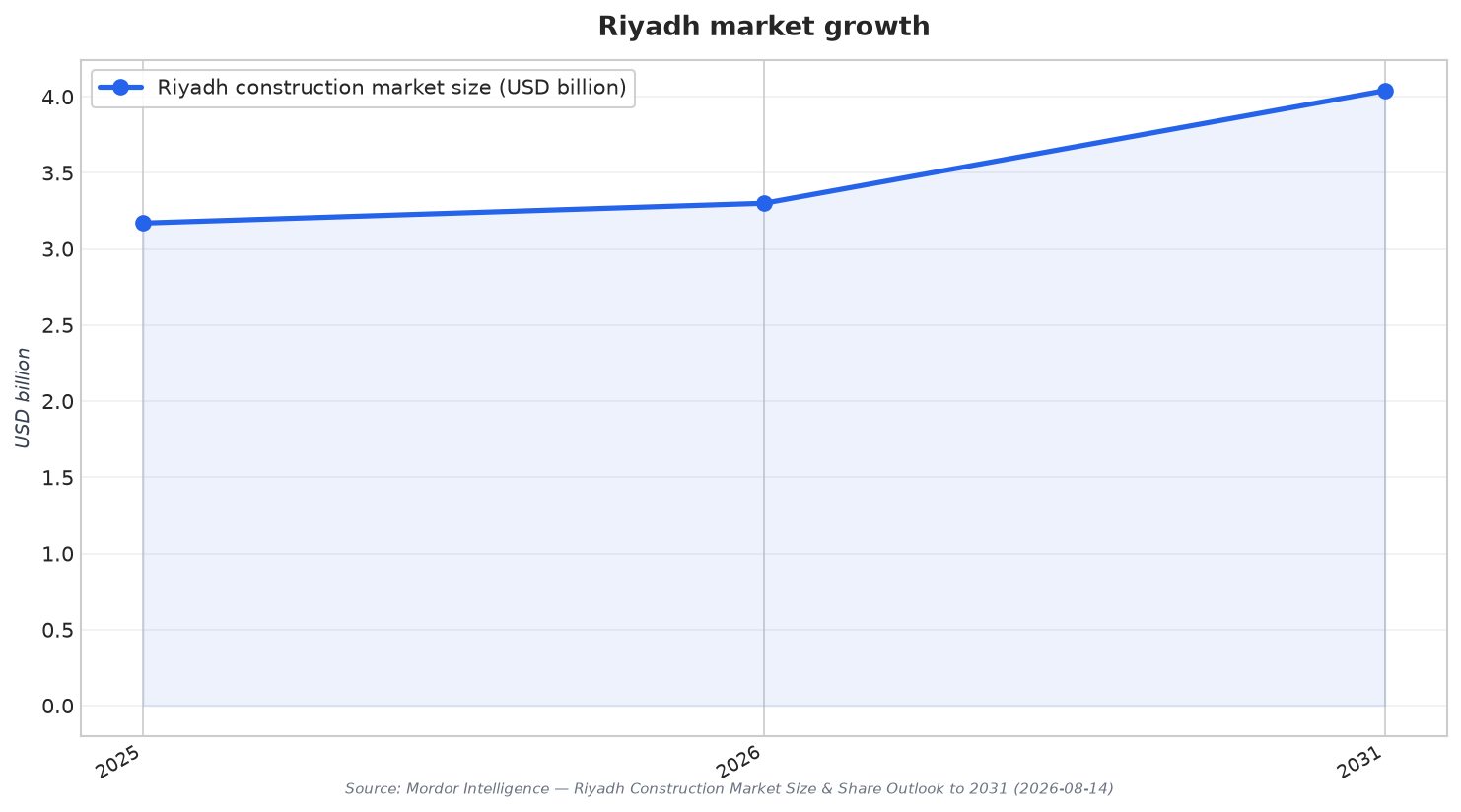
In parallel, the city market signals why Riyadh is central to bid strategy. Mordor Intelligence values the Riyadh construction market at USD 3.17bn in 2025 and estimates it at USD 3.3bn in 2026, reaching USD 4.04bn by 2031, with a 4.12% CAGR during 2026-2031. In 2025, residential led with 34.27% share, while new-build accounted for 79.45% of activity, and conventional on-site methods held 86.75% share, even as modern methods advance at a 6.50% CAGR. Public-sector investment represented 60.78% share in 2025. For bidders, that mix points to public procurement discipline, a large new-build workload, and rising competitiveness for contractors who can industrialize delivery without overpromising on schedule.
How to Position for Riyadh’s Tender Waves and Delivery Risks
Contractors and consultants should map training-facility opportunities against the wider event and city programme overlaps. Ventures Onsite frames Expo 2030 Riyadh and FIFA World Cup 2034 as back-to-back mega-event infrastructure programmes with a combined pipeline exceeding USD 100bn, spanning infrastructure, stadiums, hospitality, and transport. It also states the tournament is planned across 15 stadiums in Riyadh, Jeddah, Al Khobar, Abha, and NEOM. Separately, Mahad Manpower Research states the 2034 World Cup will use eleven stadiums across the same five host cities. The practical takeaway for bidding teams is to track packages by client and cluster, then prioritize enabling works, utilities interfaces, and operations-led requirements that training sites often depend on, rather than treating them as isolated builds.
Capacity planning is a bid differentiator, not a back-office task. Mahad Manpower Research warns that the 2034 World Cup pipeline alone will absorb roughly two hundred thousand additional skilled trade workers above baseline. It also notes re-clearance after initial medical failure is possible in roughly 35% of cases, while 65% of failed medicals require candidate substitution, and recommends 10-12% candidate over-recruitment buffers to avoid pipeline disruption. Mordor’s Saudi construction report adds that Saudization rules raise the local labor quota to 30% by 2027, pushing contractors toward training academies that certify 500 workers annually in critical skills, while visa transfer limits hinder redeployment of expatriate teams between sites. Together, these constraints should be reflected in method statements, mobilization schedules, and consultant reviews of programme realism.
Procurement strategy also matters because resource pressure is already changing how work reaches the market. Mordor reports that rental rates for 400-ton cranes in Riyadh jumped 25% in 2025 and lead times stretched to eight months, inflating preliminaries. It adds that developers respond by packaging work in smaller lots and staggering tender releases to ease pressure on resources. For firms targeting a World Cup training facilities tender, that implies two practical moves: build repeatable “lot-ready” delivery teams that can bid multiple smaller packages without diluting control, and align design coordination to digital delivery expectations noted in Riyadh’s market narrative, such as broad use of BIM across packages to reduce clashes and rework. Winning bidders will be those who show they can staff, procure, and sequence work credibly under these constraints.
How should bidders approach a World Cup training facilities tender in Riyadh?
What is the scale of Saudi Arabia’s forward projects pipeline?
What market signals show Riyadh’s construction workload is expanding?
What labor and compliance constraints should contractors plan for?
Why are tender packages being split into smaller lots in Riyadh?