The market context for sponsorship work in Saudi Arabia is tied to the wider marketing and advertising agency economy. Mordor Intelligence values the Saudi Arabia marketing and advertising agency market at USD 3.02 billion in 2025 and estimates growth from USD 3.19 billion in 2026 to USD 4.13 billion by 2031, at a 5.3% CAGR (2026-2031). The same source links expanding mega-events to higher agency retainers and broader service requests. Ken Research also cites a 2025 market value of USD 3,020 million, a projection to USD 4,130 million by 2031, and a forecast CAGR of 5.36%, while noting agencies compete on measurable revenue contribution. This environment is the backdrop in which sponsorship activation agencies in Saudi Arabia pitch for budgets, measurement, and long-term relationships.
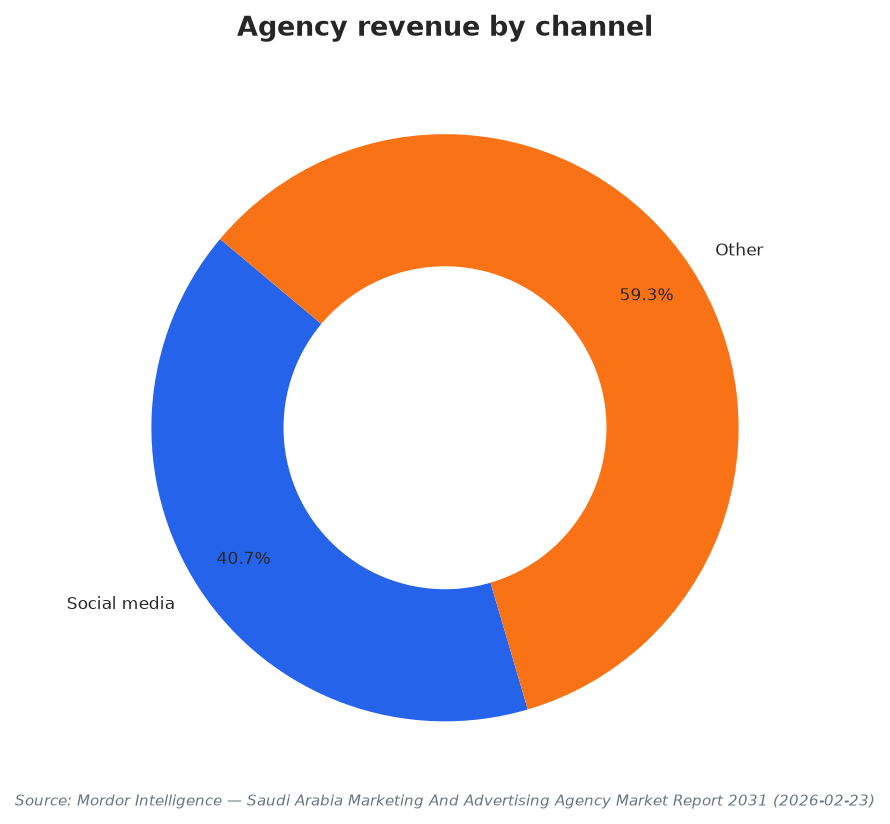
Client demand is increasingly digital-first and attribution-driven. Mordor reports digital advertising services at 61.84% of revenue in 2025, social media at a 40.66% allocation in 2025, and data-and-analytics-led services expected to expand at a 5.95% CAGR through 2031. It also states influencer and creator marketing is forecast to grow at a 6.36% CAGR through 2031. For sponsorship activation, these figures matter because many activations now combine event, creator, social, and performance layers that can be measured. Ken Research adds that agencies operate through retained relationships, project-based creative assignments, media-planning commissions, technology implementation, and performance-linked fees. That mix supports sponsorship programs that need both execution and reporting, not only creative concepts.
Services Sponsors Typically Buy From Activation Agencies
In practice, activation services often bundle planning, production, and measurement. Syncs describes ROI tracking through engagement metrics such as footfall and dwell time, lead generation (contacts captured and qualified leads), business outcomes (sales lift and new customers), digital impact (social reach and video views), and qualitative feedback. It also frames mall activations as a common format that uses high foot traffic and “digital displays and activation spaces,” and it positions experiential work as requiring cultural understanding, technical production, operational precision, and rigorous measurement. Mordor’s coverage model split adds a structural clue: full-service agencies held 45.71% share in 2025, while specialist or boutique agencies are advancing at a 6.11% CAGR, supported by demand for programmatic buying and Arabic gaming-influencer expertise. For sponsorship, that means buyers may choose an integrated shop for end-to-end delivery or a specialist for a specific activation channel.
Fees are rarely one-size-fits-all, and the sources describe multiple charging models rather than fixed price lists. Ken Research outlines retained agency relationships, project-based creative assignments, media-planning commissions, technology implementation, and performance-linked fees as common structures. It also says pricing is gradually moving from time-and-material billing toward retainers, outcome-linked fees, and technology-enabled managed services. Mordor similarly highlights that marketers demand attribution, lifetime-value modeling, and real-time optimization, which naturally supports fees tied to performance and reporting. On the technology side, sponsor activation platforms are positioned as the “backbone” for designing and measuring activations. Dataintelo values the global sponsor activation platform market at $3.8 billion in 2025 with a projection to $9.6 billion by 2034 (CAGR 10.8% for 2026-2034), while Marketintelo values the global market at $1.2 billion in 2024 with a forecast to $4.8 billion by 2033 (CAGR 16.7%). These are global figures, but they explain why technology implementation can appear as a distinct line item in agency proposals.
Where demand sits inside the Kingdom also affects delivery and staffing. Ken Research estimates Riyadh accounts for 54.0% of agency revenue in 2025, followed by Jeddah at 24.0% and the Eastern Province at 13.0%, and it cites 1,340 total players in 2025. It also points to approximately 1.6 million active commercial registrations in Q4 2024 as a broad advertiser base, and to 154,640 new registrations in Q1 2025 as a factor behind faster SME growth (Mordor projects SMEs as the fastest-growing at a 5.61% CAGR to 2031). For sponsorship activation agencies, this mix signals two parallel pipelines: large enterprises that already led with 53.74% share in 2025 (Mordor), and a growing SME base seeking measurable, digital-heavy activations. In both cases, the message from the sources is consistent: measurement expectations are rising, and service scopes are expanding beyond logo placement into trackable, multi-touchpoint experiences.
What is driving demand for sponsorship activation agencies in Saudi Arabia?
What services do activation agencies typically include in sponsorship work?
How do agencies in Saudi Arabia typically charge for sponsorship activation work?
Why is measurement and technology becoming more central to sponsorship activation?
Where is agency activity concentrated inside Saudi Arabia?