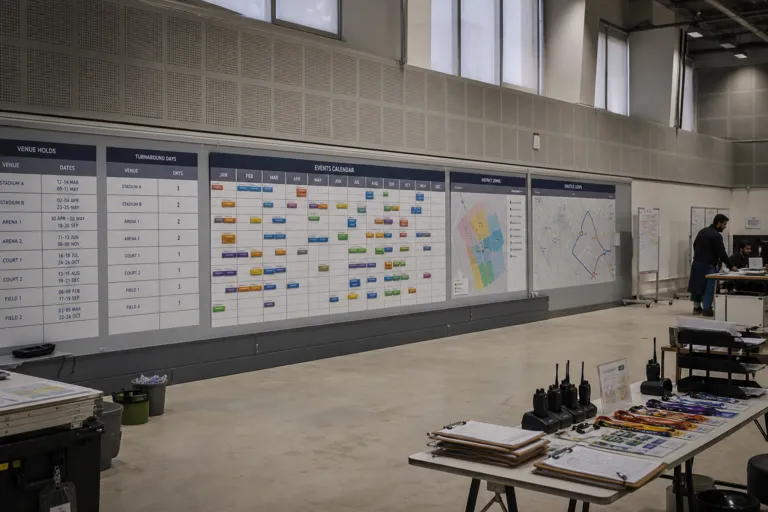
Diriyah is being built as a destination brand, not just a heritage stop. A core tool is its calendar approach: sports and entertainment moments that keep the place visible beyond a single peak season. The Public Investment Fund (PIF) describes Diriyah’s shift “from national icon to global must-visit destination,” with a stated target of 50 million visits per year by 2030. That kind of ambition makes programming a utilization strategy, because a district can launch with excitement but still struggle if repeat visitation is weak. In practical terms, events become the habit-forming loop that gives locals and visitors reasons to return, while also supporting hotels, restaurants, retail, and public realm activity across the year.
This is where Diriyah sports events fit the destination narrative. The broader Saudi model is to build event-platforms that combine entertainment, sport, retail, and culture into concentrated bursts that attract attention and then stack coverage across categories. “Saudi Seasons” are framed as months-long platforms, including Diriyah Season, designed to deliver concentrated global media coverage. That matters because the story does not stay siloed: sports investment narratives and giga-project narratives reinforce the same Vision 2030 diversification message, so visibility compounds in search and media. In that context, sports programming is not only about fans on the day; it becomes a branding asset that can keep Diriyah in the conversation between major travel decision windows.
Why the Calendar Matters More Than a Single Mega-event
Several sources underline that the risk for giga-projects is utilization, which is why “event calendar depth” sits beside annual footfall and hotel occupancy as a success indicator. Diriyah also benefits from being “Riyadh-adjacent,” connected to the capital’s corporate, diplomatic, residential, and event economy. That proximity supports repeat attendance and makes frequent programming more feasible than a remote, once-a-year model. At the same time, Diriyah’s strategy is being built in parallel with national mega-events that will increase demand for rooms, venues, and visitor-ready districts. Diriyah Company’s CEO said the development timetable is intended to benefit from Expo 2030 and the FIFA World Cup in 2034, with infrastructure, hotel rooms, restaurants, and cultural assets positioned to help welcome the world.
The development narrative also includes explicit economic and jobs-related projections presented at Diriyah Development headquarters: an economic contribution exceeding $18.6 billion, 180,000 new jobs, and 100,000 new residents. The same account described projections of 50 million annual visits “within five years,” highlighting how closely visitation goals are tied to the buildout timeline. Separately, Visit Saudi states that more than 27 million visitors are expected to visit the At-Turaif District annually by 2030, tying heritage preservation to sustained demand. In a destination brand built on both culture and hospitality, sports programming can add frequency: it creates more date-specific reasons to travel, which can help smooth demand across months rather than relying on one marquee moment.
Finally, the calendar strategy sits inside a wider construction and event pipeline that can pull attention toward Riyadh and nearby districts like Diriyah. Wired reports additional strain from an expanding mega-event schedule that includes the 2027 AFC Asian Cup, Expo 2030, and the 2034 FIFA World Cup, with the World Cup alone requiring 11 new stadiums. That pressure makes “ready-to-use” destinations valuable, because they can absorb visitor flows with hotels, restaurants, and cultural assets. Diriyah’s bet is that recurring programming, including sports-led moments, will convert that global attention into repeat, year-round visitation—and make the destination brand resilient after the headline events pass.
What is Diriyah’s stated visitation target for 2030?
How do sports events support Diriyah’s year-round destination brand?
What 2030 visitor figure is cited for the At-Turaif District?
Which upcoming mega-events are mentioned as relevant to Riyadh and Diriyah planning?
What projections are cited for Diriyah’s wider economic and jobs impact?