Saudi Arabia’s Regional Headquarters (RHQ) Program is a licensing scheme run by the Ministry of Investment (MISA) with the Royal Commission for Riyadh City, designed to authorize a multinational group to operate a MENA-wide administrative center from the Kingdom. It was announced in February 2021 and became binding for procurement purposes on 1 January 2024. For international sports businesses, that timing matters because the program is framed as both a mandate and an incentive package, and many companies misread it as only a tax play. In practice, the program functions as a procurement rule with an attached incentive for those that take the licence, and it is increasingly shaping where multinationals place regional decision-making in the Gulf.
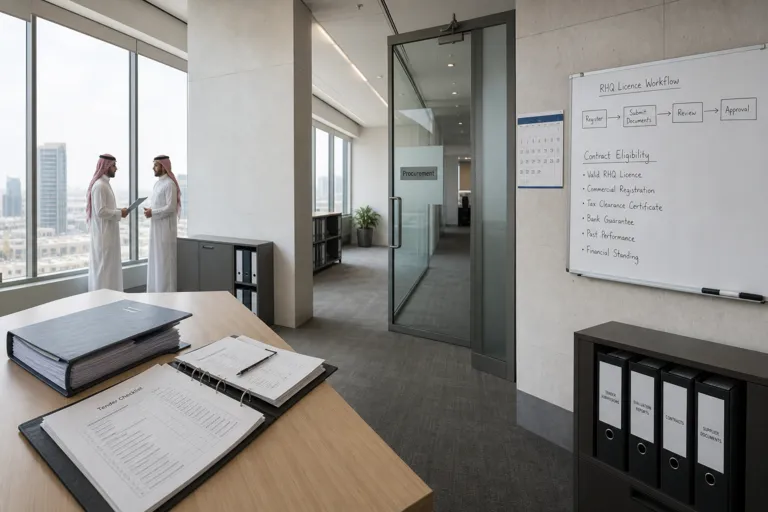
The clearest operational trigger is contract eligibility. Since 1 January 2024, a foreign company without a licensed RHQ in the Kingdom cannot be awarded a central-government or state-entity contract worth more than SAR 1m (about $266,000). Separate commentary also describes the mandate as applying to Saudi government agencies, state-owned enterprises, sovereign wealth funds, and government-affiliated entities, tying procurement access to holding an RHQ licence in Riyadh. For sports companies, this can touch workstreams beyond events, such as facilities, services, and other engagements where a state-linked entity is a counterparty. The consequence is structural: you can be caught by the procurement rule even if you do not qualify for, or do not take, the incentive package.
What an RHQ Licence Lets You Do (and What It Does Not)
An RHQ licence is not a trading permit. One guide emphasizes that an RHQ is barred from revenue-generating commercial activity itself, and that commercial operations must sit in separately licensed affiliates. Another explains the practical intent: the RHQ should direct, manage, and oversee operations across a defined region from Saudi Arabia, focusing on regional coordination and strategic functions. Activities cited for an RHQ include strategic management, financial planning, human resources coordination, procurement oversight, compliance management, marketing support, and regional business development, with the final scope depending on the approved licence. For international sports groups, that implies a careful split between a regional management entity in Riyadh and operating entities that execute local sales or delivery.
On incentives, one source describes a 30-year 0% corporate income tax and withholding tax package for compliant companies, alongside a 10-year exemption from Saudisation quotas. Separately, a legal briefing notes that holding an RHQ licence can provide additional workforce flexibility during establishment and growth, while remaining subject to Saudi employment, immigration, and labor compliance requirements generally. It also notes that holding an RHQ licence may facilitate eligibility for premium residency (the Privileged Iqama) for qualifying senior RHQ personnel. Taken together, the message for sports brands is that the RHQ structure is an operating model choice, not just a mailing address, and it should be designed to match what the licence permits.
Company uptake is widely reported, but it is also described with important caveats. As of the first quarter of 2026, one guide reports more than 780 international firms held RHQ status, against an original Vision 2030 target of 480 by 2030. Another source attributes a similar “over 780” figure to CBRE’s Q1 2026 review and adds that those firms are actively maintaining a physical presence in Riyadh. Elsewhere, early 2026 is described as “more than 540” RHQ licences issued, and another briefing says “more than 700” international companies have established RHQs. At the same time, one source stresses that MISA publishes a licence count, not headcount, floor space, payroll, or an operational-status register, so depth is harder to verify than licence totals.
What is Saudi Arabia’s RHQ Program and why does it matter to international sports companies?
What is the key procurement threshold under the RHQ rule?
Can an RHQ entity generate revenue directly in Saudi Arabia?
What incentives are highlighted for companies that comply with the RHQ framework?
How should regional headquarters program sports companies interpret the reported RHQ licence counts?