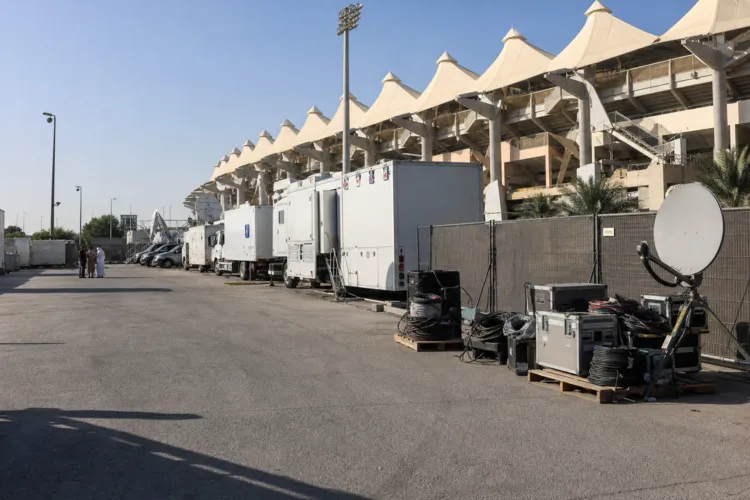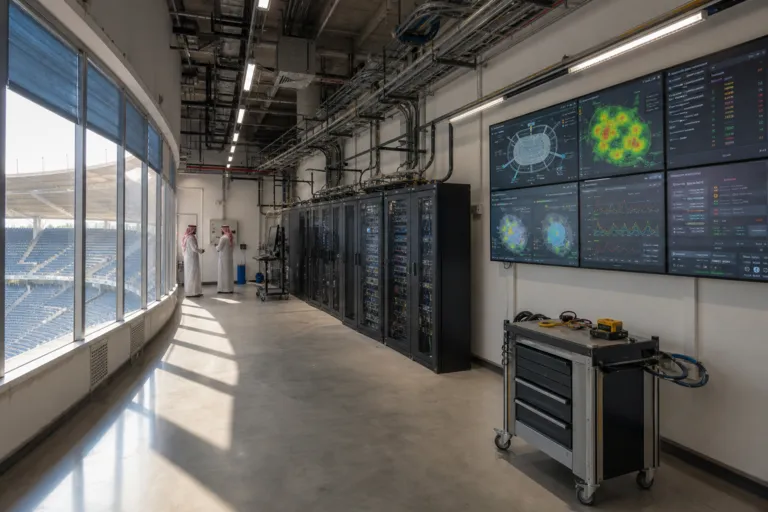
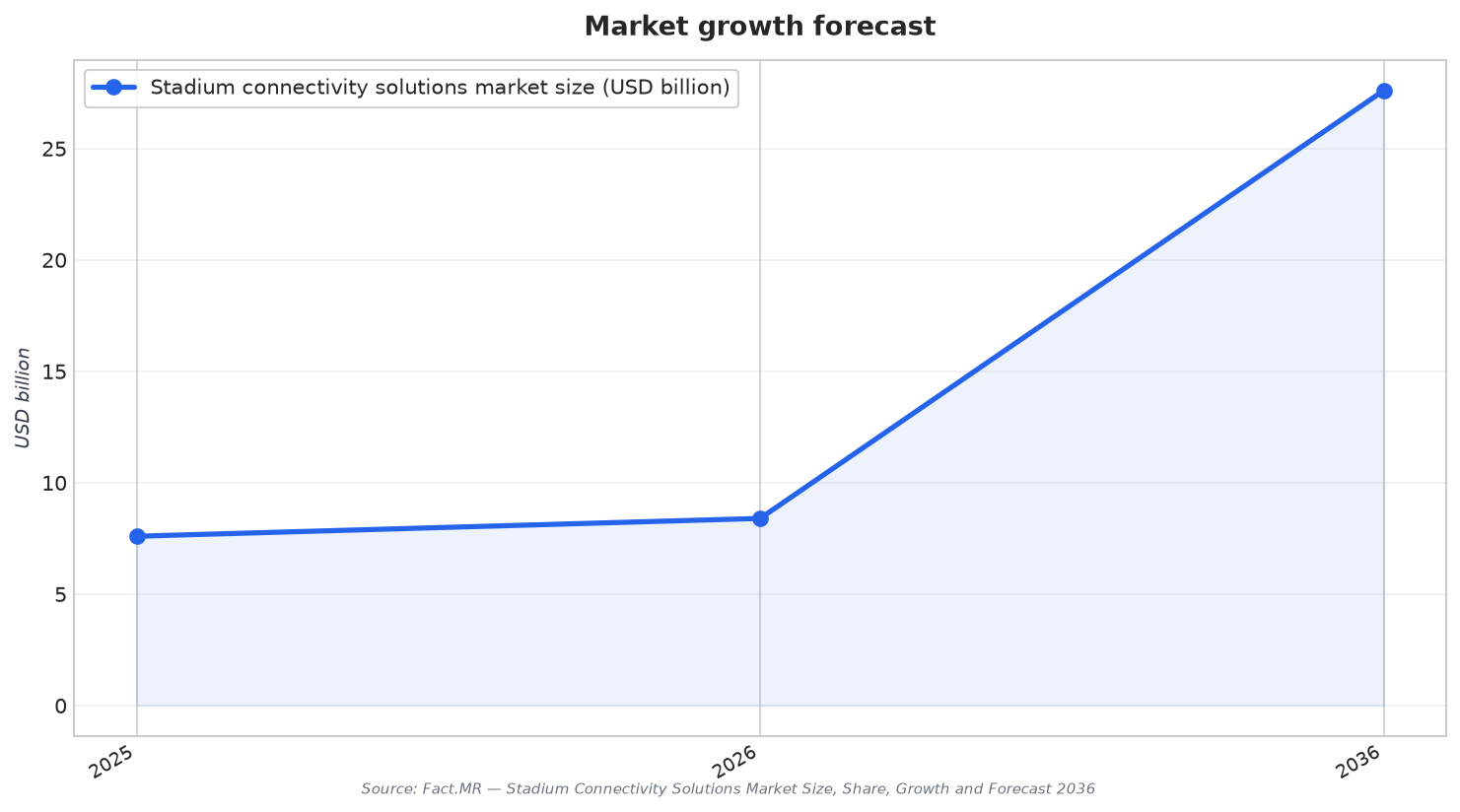
Connected venues are becoming an operating layer, not an add-on. For stadium 5G connectivity in Saudi Arabia, the stakes rise as the country prepares for 2034 venues described in market research as fully 5G-enabled, linked to Vision 2030 and similar development agendas. In parallel, global forecasts frame how quickly solutions are scaling. Fact.MR values the stadium connectivity solutions market at USD 7.6 billion in 2025, rising to USD 8.4 billion in 2026, and projects USD 27.6 billion by 2036 at a 12.6% CAGR. These solutions are positioned as the foundation for mobile entry, real-time crowd coordination, and operational network control inside stadiums.
Private networks are a key part of that stack because event-day load can overwhelm public cellular infrastructure. DataIntelo’s Stadium Private 5G Operations market report values the global market at USD 2.8 billion in 2025 and projects USD 12.4 billion by 2033, representing an 18.9% CAGR. The report describes private 5G as dedicated wireless infrastructure deployed in sports venues, concert halls, convention centers, and entertainment complexes to deliver superior connectivity, reduced latency, and enhanced security compared with public networks. It also highlights applications that map directly to stadium operations: real-time video surveillance, crowd movement analytics, smart ticketing and in-venue transactions, asset tracking, and emergency communications designed to stay reliable during critical incidents.
What the Connected Stadium Stack Looks Like for 2034
Several market lenses explain what vendors and venue owners are buying. DataIntelo’s 5G Stadium Solutions research values that global market at USD 4.2 billion in 2025 and projects USD 18.6 billion by 2034, growing at an 18.0% CAGR. The same source states the Middle East & Africa region is currently the smallest revenue share, but is growing at the highest relative pace in select markets, naming Saudi Arabia, the UAE, and Qatar and referencing fully 5G-enabled venues for the 2034 FIFA World Cup in Saudi Arabia. It also describes “smart stadium districts,” where 5G coverage extends beyond the venue into surrounding public spaces, transport hubs, and commercial zones, expanding project scope and budget.
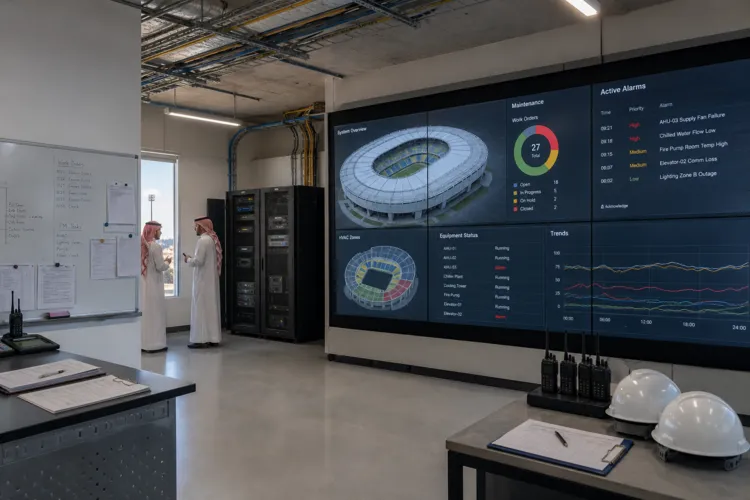
Above the radio layer, smart stadium platforms pull together IoT sensors, edge computing, and AI analytics. MarkWide Research describes smart stadium infrastructure as processing sub-second latency data streams from tens of thousands of connected endpoints, enabling real-time crowd flow optimization, energy load balancing, and personalized content delivery to spectator devices. It notes that Wireless Connectivity is the fastest-growing technology layer as venues replace legacy distributed antenna systems with private 5G networks, and that deployments often favor Hybrid Cloud architectures that balance on-premises edge processing with cloud-based analytics. Vendor positioning is also consolidating: MarkWide points to Huawei competing with integrated 5G infrastructure bundles across Asia-Pacific and Middle Eastern markets.
Market segmentation data indicates where budgets can concentrate during stadium build-outs and upgrades. Fact.MR expects High-Density Wi-Fi to hold a 37.0% share in 2026, with Network Hardware leading components at 41.0% share in 2026, and Managed Venue Connectivity reaching 34.0% share in 2026. It also projects Outdoor Stadiums at 46.0% share in 2026 and Fan Engagement Connectivity at 39.0% share in 2026, tying investment to entry control, concessions, and app-ready experiences. In the broader smart stadiums market, Straits Research values the global market at USD 19.46 billion in 2025 and estimates USD 74.91 billion by 2034 at a 15.6% CAGR, describing growth driven by IoT, AI, and 5G connectivity to improve fan engagement, operations, and safety management.
What does stadium 5G connectivity in Saudi Arabia need to support for 2034 venues?
How large is the global stadium connectivity solutions market in the sources?
What is the forecast for the global stadium private 5G market?
Which connectivity and deployment segments are highlighted for stadium projects?
What technical building blocks define a smart stadium in these sources?