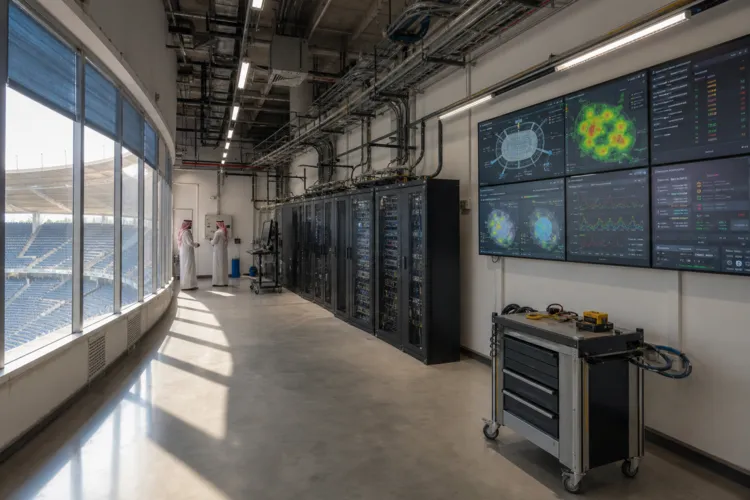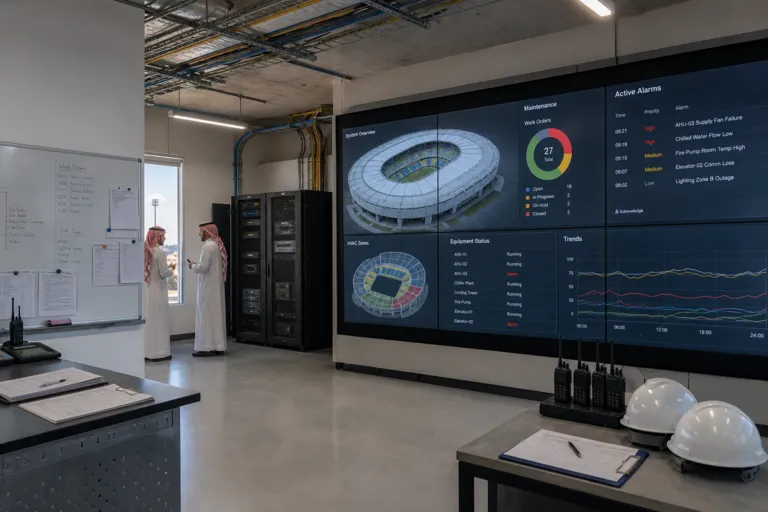
Demand for stadium digital twin Saudi Arabia projects is rising inside a broader national digital twin wave. IMARC values the Saudi Arabia digital twin market at USD 349.7 million in 2025 and projects it to reach USD 21,394.9 million by 2034, at a CAGR of 57.95% over 2026–2034. The same source links digital twins to real-time monitoring, predictive maintenance, and more efficient resource management. It also ties momentum to IoT expansion, stating the Saudi Arabia IoT market size reached USD 9,490.7 million in 2024, with sensors feeding operational data into digital twin platforms. For venue operations, that combination frames why O&M teams are looking beyond point solutions toward connected models of assets, spaces, and workflows.
Stadium operators in the Kingdom are not making these decisions in isolation. Mordor Intelligence sizes the Saudi Arabia event management market at USD 2.59 billion in 2025, expects USD 2.77 billion in 2026, and forecasts USD 3.92 billion by 2031 at a 7.14% CAGR for 2026–2031. It also reports average venue utilization at 68% in Riyadh and 61% in Jeddah as of 2025, putting pressure on maintenance windows, staffing, and uptime. On supply, the same report says more than 100 new event-ready facilities are slated for completion under giga-projects such as NEOM, Qiddiya, and the Red Sea destination, including King Salman International Stadium’s 92,760-seat bowl. More venues and tighter calendars elevate the value of predictive maintenance, simulation, and cross-team coordination that a stadium twin can support.
Vendor Market Snapshot: What Stadium Twins Need to Deliver
Globally, digital twin stadium offerings are sold as software, hardware, and services, and used across event management, facility management, security and surveillance, fan engagement, and asset management, according to Dataintelo. Two separate global studies size the digital twin stadium market at USD 2.8 billion in 2025 (Dataintelo) and USD 2.72 billion in 2025 (Growth Market Reports), underscoring rapid expansion but also differences in estimation methods. For operations, Dataintelo highlights integrations across gate access, environmental controls, structural monitoring, and crowd management. It also cites optimized HVAC based on real-time occupancy patterns that reduced operational costs by approximately 18–24% at specific venues outside Saudi Arabia, which can be treated as a use-case signal rather than a local benchmark.
In practice, the vendor conversation in Saudi venues often converges on cloud access, remote monitoring, and multi-stakeholder collaboration. Growth Market Reports argues cloud deployment helps operators access platforms from any location and share data across teams, which matters when multiple venues or touring organizers must coordinate. The same report names Siemens AG for digital twin solutions integrating IoT, AI, and advanced analytics for operations and energy management, IBM Corporation for AI-powered monitoring and predictive maintenance, and Microsoft Corporation for Azure Digital Twins-based cloud deployment. Stadium lighting also appears as a specialized vendor lane: a Yahoo Finance summary projects the digital twin stadium lighting market expanding from USD 1.37 billion in 2025 to USD 3.22 billion by 2030 at an 18.6% CAGR, and describes benefits such as scenario simulation, real-time monitoring, predictive maintenance, and energy efficiency.
Saudi smart-stadium investment adds another layer to vendor requirements: performance, sustainability, and dense sensing. Market Growth Reports states that Qatar and Saudi Arabia have invested in 100% climate-controlled smart stadiums that use 30% less energy than traditional designs, and that the Middle East and Africa region holds a 10% share of the smart stadium solution market with 80% of activity concentrated in GCC countries. It also claims Saudi Arabia leads with a 40% regional share and is building 10 new smart stadiums, alongside “45,000 sensors” typically deployed in high-capacity venues to monitor real-time crowd flow and environmental conditions. For O&M leaders, these figures imply that vendor selection should emphasize integration, data governance, and the ability to turn sensor streams into maintenance schedules, safety workflows, and repeatable operating procedures across busy event calendars.
How fast is Saudi Arabia’s digital twin market growing?
What is pushing venue operators toward digital twins for maintenance and operations?
Which vendors are commonly associated with digital twin stadium platforms globally?
How does the event pipeline affect stadium twin requirements in Saudi Arabia?
What does a stadium digital twin strategy in Saudi Arabia need to account for?