Postponement risk in sports is not only operational. It is contractual. Sponsorship and event agreements usually include contingency language for cancellation, postponement, or force majeure, because the commercial relationship depends on deliverables being real and measurable. A modern sports marketing agreement also tends to include termination triggers (including force majeure), and “makegoods” that replace a promised benefit when it is not fulfilled, such as a canceled broadcast or disrupted matchday program. This is where precision matters, because every benefit discussed in sales needs to land in the contract with enough specificity to prevent disputes when schedules slip or formats change.
For Saudi Arabia, the legal context is distinctive. Force majeure and hardship are now part of a codified framework under the Civil Transactions Law, which entered into force in December 2023. Alerts on Saudi law stress that analysis is not only about the clause wording. It is also grounded in Shari’ah principles, and the law recognizes both force majeure and “extraordinary events,” drawing a core distinction between performance that is objectively impossible and performance that remains possible but becomes excessively burdensome. This matters for sports events because reputational, security, travel, and supplier issues may disrupt delivery without making the event literally impossible.
Draft for Delays, Not Only for Impossibility
Middle East geopolitical tensions have pushed many event planners to reassess force majeure clauses, because clauses often require performance to be rendered impossible or illegal. That is a high bar when venues and flights technically remain open, even if risk levels rise and travel advisories change. Planners are adding clearer language on whether travel disruption or government advisories are enough to modify obligations, and how costs work if an event is postponed, relocated, or converted into a hybrid or virtual format. Without that clarity, financial exposure can include attrition penalties, nonrefundable deposits, and reduced flexibility to rebook, even when attendee participation is materially impacted.
Saudi law applies force majeure narrowly and the threshold is stringent. Guidance on Saudi practice explains that force majeure generally applies only where an external event beyond the parties’ control renders performance objectively impossible. It does not extend to situations where performance is merely more difficult, delayed, or expensive, and the burden of proof sits with the claimant. Courts assess anticipation strictly, by reference to a hypothetical highly perceptive person, and diminished revenues are generally treated as ordinary business risk. Remedies depend on duration and impact. Temporary force majeure may justify suspension, while prolonged events may support termination, and a party that wrongly invokes force majeure may face damages for wrongful termination.
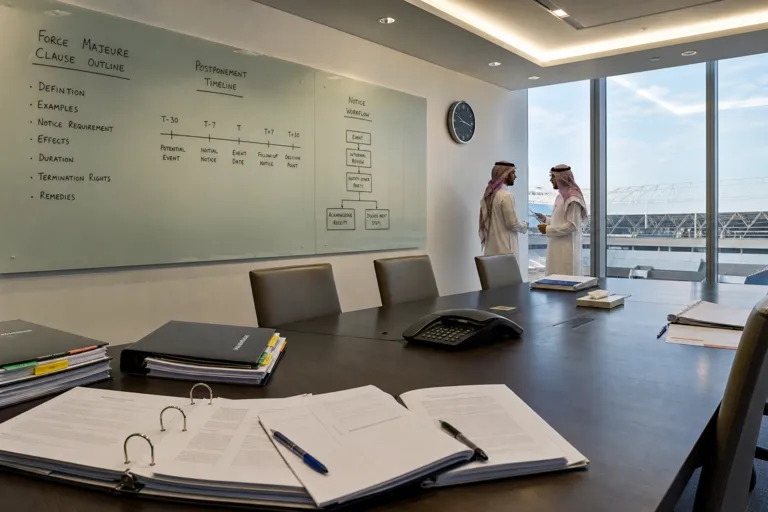
Where performance is still possible but excessively onerous, “extraordinary events” (hardship) may be the better lens for negotiation strategy. Under Article 97 of the Civil Transactions Law, unforeseeable extraordinary events that make performance excessively onerous can support a request for renegotiation, and courts may intervene to rebalance obligations rather than discharge them. For Saudi public-entity contracts, separate procurement rules may apply under the Government Tenders and Procurement Law, with distinct forums and relief concepts. For sports event force majeure in Saudi Arabia, organizers and sponsors should therefore align the contract with how relief actually works: define postponement mechanics, map notice steps, document mitigation, and pre-agree makegoods, so disputes do not depend on arguing “impossibility” after the fact.
How is force majeure assessed under Saudi law for disrupted events?
What is the difference between force majeure and hardship in Saudi Arabia?
Why do postponements create sponsor disputes even if a venue is still open?
What contract terms help manage postponement risk in sports sponsorships?
How should organizers approach sports event force majeure in Saudi Arabia when drafting contracts?