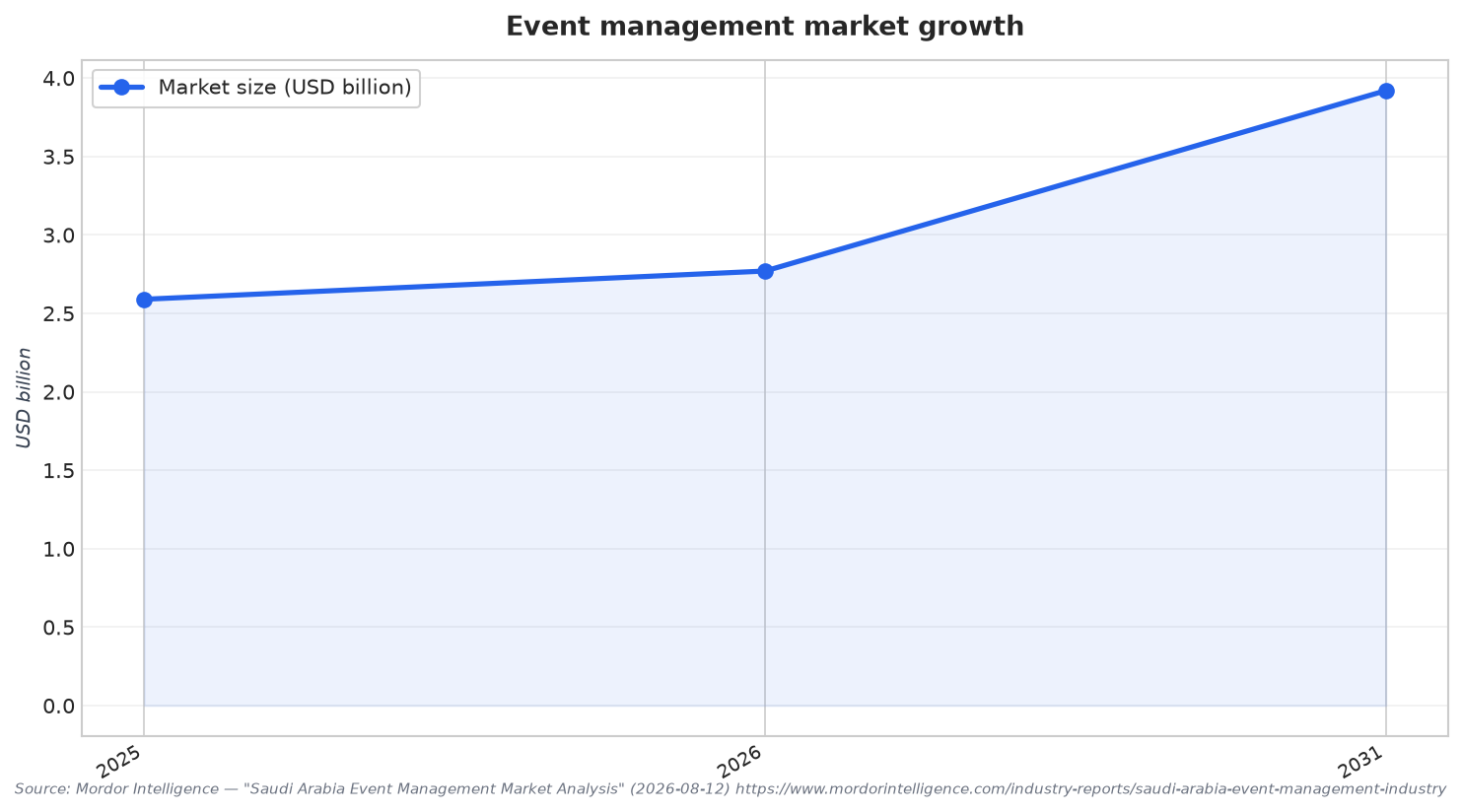
Saudi Arabia’s events ecosystem is growing, and that growth is changing how venue capacity is planned. Mordor Intelligence expects the Saudi Arabia event management market to grow from USD 2.59 billion in 2025 to USD 2.77 billion in 2026, and to reach USD 3.92 billion by 2031, at a 7.14% CAGR over 2026–2031. In that environment, overlays and demountable builds become practical tools for adding space quickly for conferences, sports, and public entertainment. Mordor also reports average venue utilization of 68% in Riyadh and 61% in Jeddah as of 2025, which signals how quickly calendars are filling. Streamlined licensing is also reshaping delivery timelines, with the same source stating foreign organizers can establish local subsidiaries in under one week.
Temporary infrastructure sits inside the wider event services stack, which includes staging systems, lighting rigs with DMX control protocols, and other production systems, as described by MarkWide Research. That same source notes that Vision 2030 giga-projects are compressing event programming cycles from annual to quarterly cadences, which pushes providers to scale temporary deployments faster than permanent venue construction permits. It also describes how municipal civil defense codes enforce crowd density and emergency egress standards for large-capacity venues, while the General Entertainment Authority licensing framework requires operational permits for public assemblies and performer engagements. For large catered audiences, MarkWide adds that mandatory HACCP certification applies to catering operations above 500 guests, shaping how temporary venues are staffed and audited.
What Is Driving the Overlay and Demountable-Venue Pipeline?
Demand drivers span both mega development and recurring programming. Mordor Intelligence states that more than 100 new event-ready facilities are slated for completion under giga-projects such as NEOM, Qiddiya, and the Red Sea destination. Its report also highlights King Salman International Stadium’s planned 92,760-seat bowl as a major capacity benchmark. On the demand side, Mordor attributes momentum to stadium construction for the FIFA 2034 World Cup, rising inbound tourism, and the localization of multinational corporate events. Corporate is already dominant in the event management mix, accounting for 58.42% of market share in 2025, while exhibitions & conferences and sports collectively captured 36.94% that same year. These patterns favor flexible build-outs that can be resized between corporate and public formats.
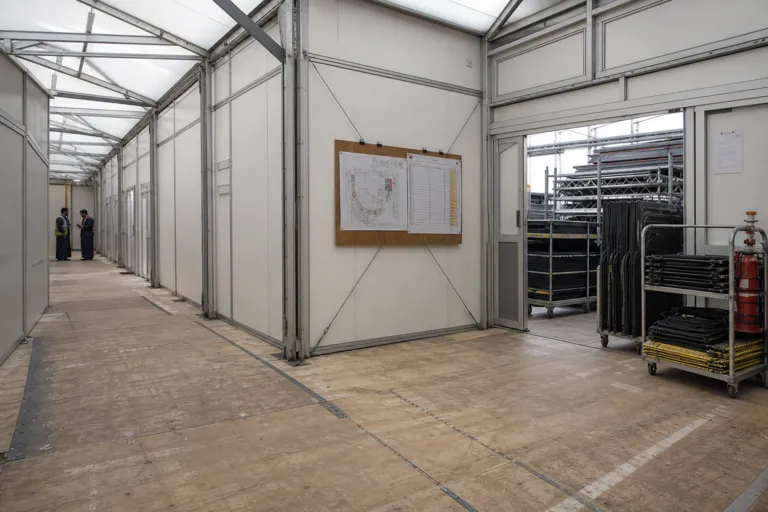
Policy, permitting, and supply-chain realities also shape how quickly temporary capacity can appear. WifiTalents reports the Saudi Council of Engineers recorded a 35% increase in temporary structure permits for events in 2023, a data point that aligns with stronger reliance on short-term structures. MarkWide Research flags a constraint: temporary staging and truss systems depend on imported structural steel subject to GCC customs fluctuations, which can compress margin buffers on fixed-price contracts. It also states that six integrated providers control 70% of giga-project panel slots, a concentration dynamic that can push mid-tier operators toward secondary cities. Technology upgrades can still reduce labor pressure; MarkWide notes pixel pitch improvements below 2.5mm enable outdoor daytime broadcasting without shading infrastructure and can reduce setup labor by 40%.
Within this environment, modular temporary venues Saudi Arabia stakeholders want are less about a single format and more about a delivery method: fast deployment, scalable seating or floor area, and compliance-ready operations. Event monetization signals why organizers keep adding capacity. Mordor reports ticket sales represented 54.92% of Saudi Arabia event management revenue in 2025, while sponsorships are expected to grow at a 12.85% CAGR between 2026 and 2031. It also notes ticketing platforms leveraging AI delivered a 15% uplift in average revenue per attendee through personalized offers and dynamic pricing. As mega-project districts scale and utilization remains high, overlays and demountable approaches can help capture peak-demand windows without waiting for long-build assets to come online.
What is the growth outlook for Saudi Arabia’s event management market?
What signals rising demand for temporary structures for events in Saudi Arabia?
Which event segments are most significant in Saudi Arabia’s event management mix?
How do modular and temporary venues fit the Saudi event pipeline?
What tech trends can reduce setup work for temporary event production?