Saudi soccer is entering a more cautious phase after a period of rapid, expensive growth. Semafor reported that Saudi clubs have paid roughly $2 billion in transfer fees since summer 2023, a level comparable to Spain over the same period, despite Saudi clubs generating a fraction of the revenue. Against that backdrop, the Ministry of Sport announced new regulations on July 1, and the Saudi Pro League’s CEO Omar Mugharbel said the objective is to raise the league’s financial strength and ensure sustainability through better governance. The shift is not just philosophical. It is starting to show up in club behavior, with fewer blockbuster moves and more scrutiny on whether spending is genuinely supportable.
The clearest example is Al-Nassr. According to reporting cited by Semafor from Saudi broadcaster Arriyadiyah, the reigning champions had not made a single signing in the window and would only be allowed to do so if they could fund a deal from their own sponsorship and commercial revenue. Arriyadiyah also put Al-Nassr’s debts at more than 800 million riyals ($213 million), prompting PIF to consider outside consultants, tighter controls on management, or even a partial sale. The club has already sought new income, including a sponsorship with HUMAIN, a PIF-owned AI company, showing how budget rules can quickly redirect clubs toward commercial growth.
Privatization and Rules Tighten the Budget Math
Governance changes are arriving alongside ownership changes. Reuters reported that the league is welcoming private ownership through a public offering, with three clubs already transferred to investment entities. It also noted a “watershed moment” when U.S.-based Harburg Group acquired Al-Kholood, the first foreign private company to buy a Saudi club, with an emphasis on developing superstars instead of buying them. Mugharbel connected the reform agenda to practical mechanisms too, saying the league reduced squad size from 30 to 25 last year, enabling more player movement and more time for Saudi players. These are levers that directly affect payroll planning and recruitment strategy.
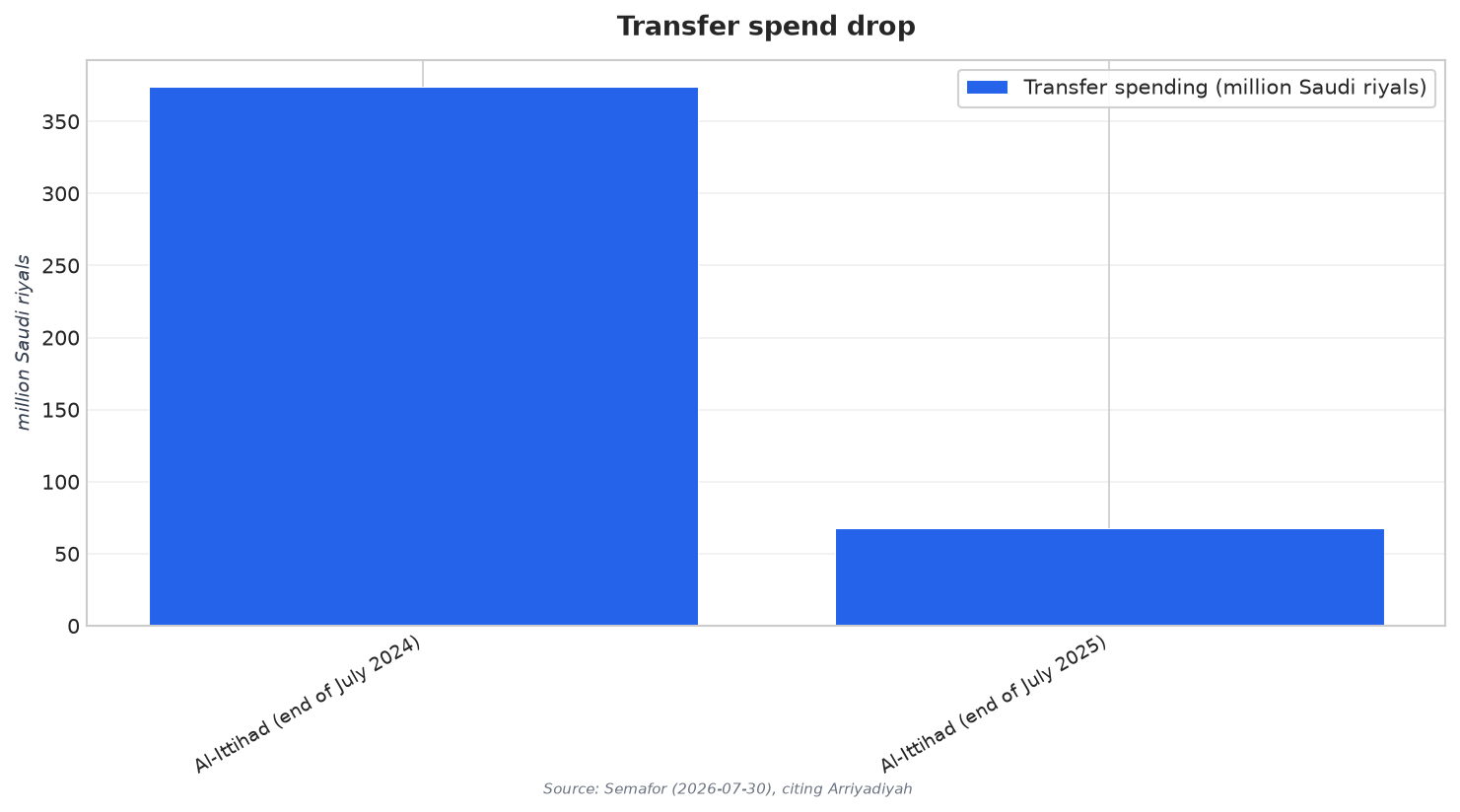
Other spending comparisons underline how quickly club budgets can tighten. Semafor reported that Al-Ittihad spent about 374 million riyals ($100 million) by the end of July 2024, but only about 68 million riyals at the same point the next year amid reports of a liquidity crisis. Yet the new environment is not uniform. Al-Hilal, no longer under PIF ownership, signed Crysencio Summerville from West Ham United for a reported $91 million, described as the Saudi Pro League’s second-most-expensive transfer ever. Semafor also said billionaire Prince Alwaleed bin Talal controls a 70% stake worth $373 million, illustrating how privatization can create different spending ceilings across clubs.
These policy shifts matter because the league’s transformation has widened gaps. A 2025 Frontiers study measured competitive balance across ten seasons (2014/15 to 2023/24) and argued the league’s growth has come with greater imbalance, driven by concentration of capital and talent in a small number of teams. Using Transfermarkt data, the study said the league’s estimated market value rose from about €370 million in 2021–22 to about €970 million in 2023–24, while Al-Ahli, Al-Hilal, and Al-Nassr increased by about 450%, 330%, and 250%, respectively. In that context, Saudi Pro League financial sustainability rules are now positioned as a corrective: they can restrain excess, but they also make ownership structure and revenue-building even more decisive in shaping who can spend.
What triggered the shift toward tighter budgets in the Saudi Pro League?
How are the new sustainability rules affecting Al-Nassr’s transfer plans?
What do the reforms mean for squad planning and player minutes?
How does privatization connect to Saudi Pro League financial sustainability?
Are all clubs cutting spending at the same rate?