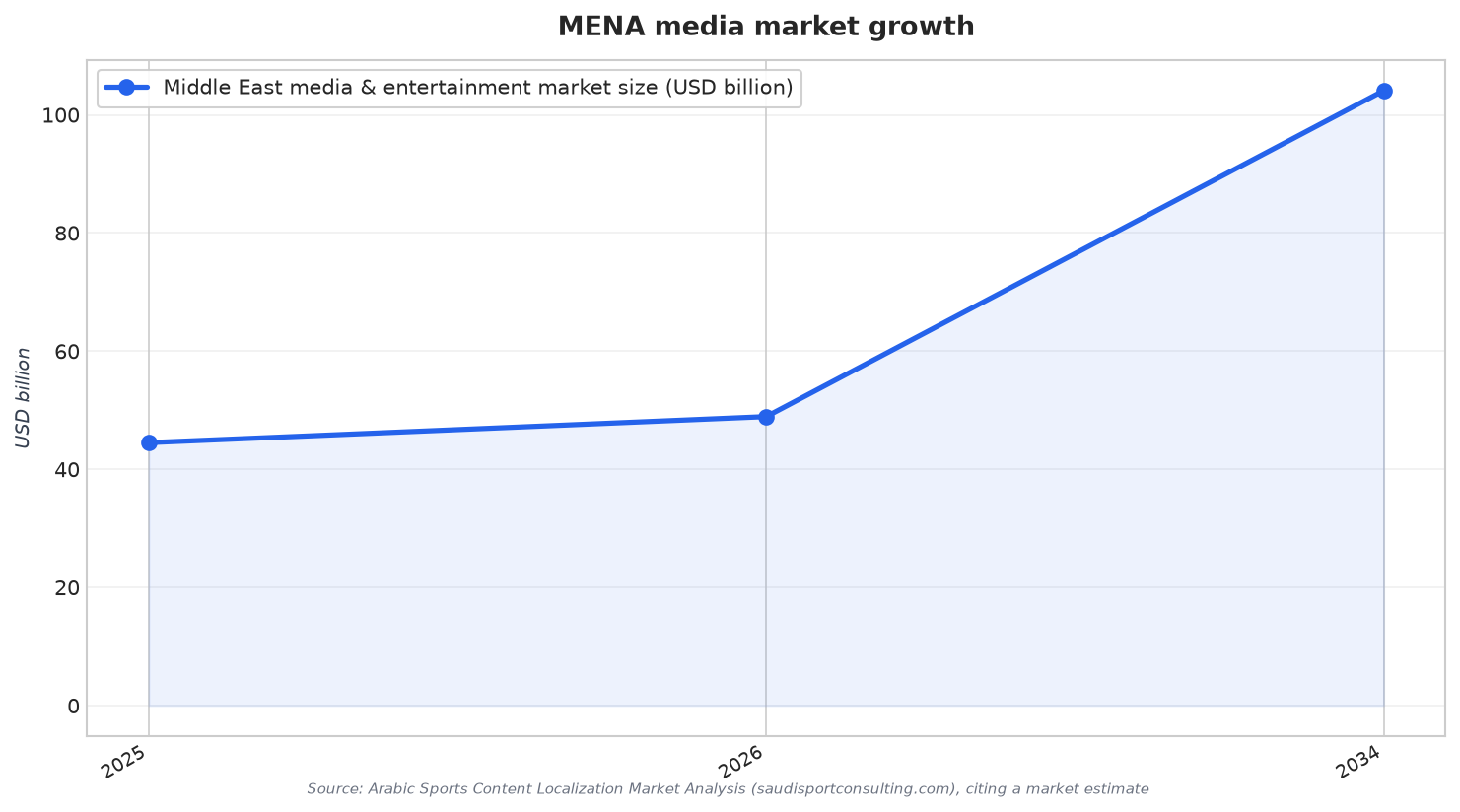
Saudi sports rights-holders are building bigger content operations as the Middle East’s media consumption shifts toward digital distribution and always-on formats. One market estimate values the Middle East media and entertainment market at USD 44.51 billion in 2025 and USD 48.92 billion in 2026, projecting USD 104.10 billion by 2034 with a 9.90% CAGR from 2026 to 2034. In that same regional context, Saudi Arabia is cited with a 39.22% share of the Middle East media and entertainment market in 2025. Those trajectories matter because rights holders are expected to deliver not only full-match coverage, but also localized studio formats, clips, and social-first narration designed for Arabic audiences.
The demand pressure is measurable, and it explains why automation is becoming part of the production plan rather than an experiment. Internet penetration in the Middle East has reached 85% (International Telecommunication Union). The World Bank says 65% of the population in Arab states is under 30, and youth in Saudi Arabia and Egypt represent over 60% of internet users. In 2023, Arab youth spent an average of 3.7 hours per day on digital entertainment (YouGov), while short-form video engagement on TikTok and Instagram Reels saw a 62% year-on-year increase. For rights-holders, those habits turn highlights, micro-clips, and localized metadata into recurring production tasks that can quickly inflate costs if they remain fully manual.
Where Automation Cuts Work: Highlights, Localization, and Metadata
Several sources point to concrete workflow areas where AI tools reduce repetitive effort. Gitnux reports that 49% of broadcasters are piloting AI for sports highlights, signaling that automated clipping is moving into mainstream trials. The same source cites a broadcast archive digitization project that reported a 35% reduction in labor costs after deploying AI for automated tagging and OCR, plus AI-enabled subtitling that reduced total localization cost by 41% versus manual subtitling in a 2023 multi-market rollout. It also notes a vendor pricing study reporting $0.15 per minute cost for AI speech-to-text in broadcast transcription use cases. Together, these figures map directly to rights-holder pain points: making more highlight variants, enriching media asset management with searchable metadata, and accelerating Arabic localization for multi-platform distribution.
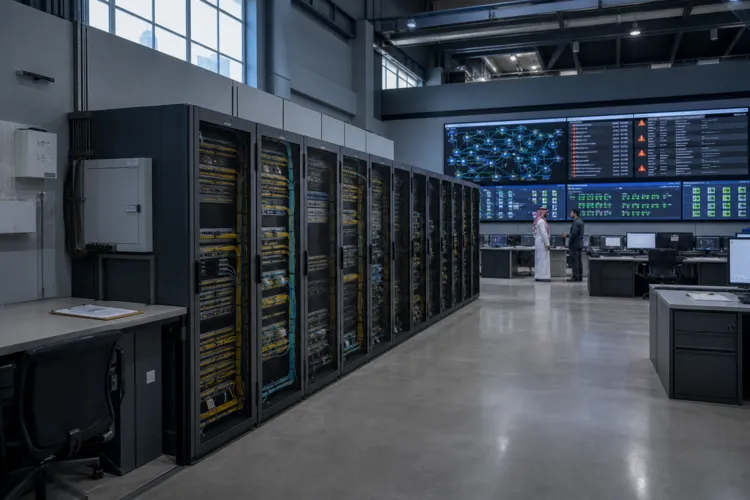
At the system level, Saudi production trends also align with automation-friendly infrastructure. Ken Research describes Digital Broadcasting (HD, 4K, 8K) as dominant in Saudi Arabia, reflecting a transition away from SD and traditional linear signals toward IP-based and ultra-high-definition workflows. It highlights software for supporting high-definition, 4K, and IP-based broadcasting, OTT delivery, and cloud production workflows, while services growth is linked to systems integration, managed playout, and cloud operations. This is where AI broadcast automation sports strategies become practical: cloud-connected media management and IP production make it easier to standardize ingest, tagging, clipping, and localized packaging across venues and rights packages without multiplying crews for every output version.
Global context shows why sports operators are prioritizing automation as rights and distribution stakes rise. WSC Sports cites Morgan Stanley’s view that AI tools could cut TV/film production costs by ~30%, and it frames automation as a way to create more content at scale for broadcasters and rights-holders. Separately, Grand View Research notes that cloud-based production and artificial intelligence-driven camera automation can improve production efficiency, reduce operational complexity, and support automated content localization and customized advertising delivery. In Saudi Arabia, where the ecosystem includes participants such as SSC, SBA / KSA Sports, stc (including stc tv), Shahid (MBC Group), OSN, and beIN SPORTS, the cost question often becomes operational: how to deliver more localized outputs across digital channels while keeping production complexity under control.
How does AI-assisted broadcast automation reduce costs for sports rights-holders?
Which Saudi broadcast trends make automation easier to deploy?
What audience signals in the Middle East push rights-holders to produce more clips and localized content?
How large is the AI-generated sports commentary market globally?