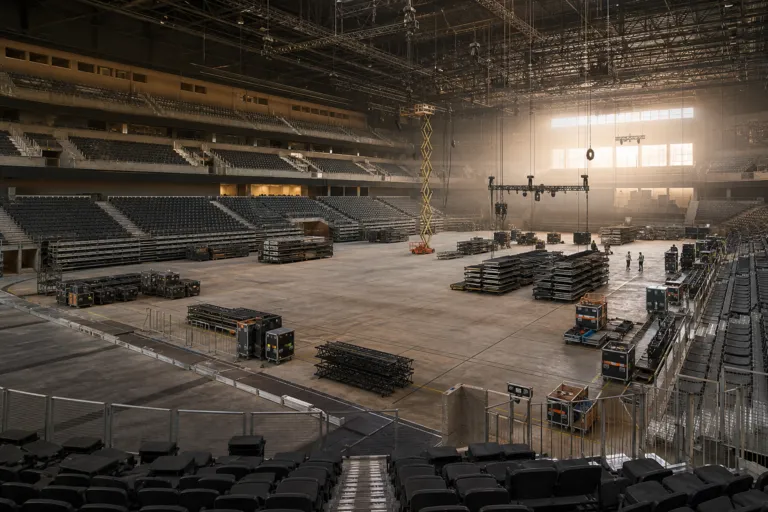
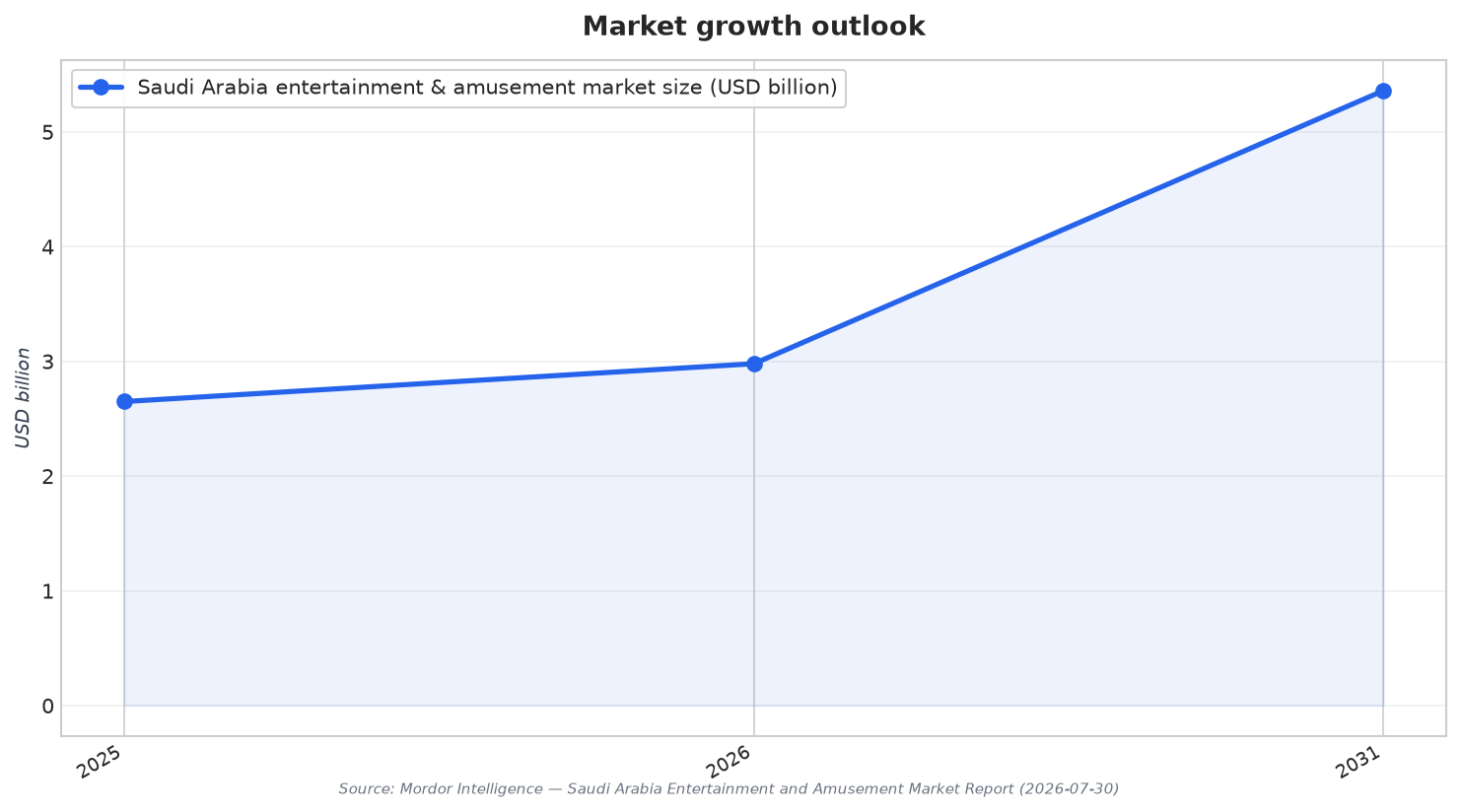
Indoor arena development in Saudi Arabia is increasingly tied to a simple commercial logic: year-round programming needs year-round buildings. Indoor venues are described as more expensive to build and operate, but also necessary for continuous calendars that go beyond seasonal festivals. That shift is happening alongside a broader expansion in paid entertainment. Saudi Arabia’s entertainment and amusement market is estimated at USD 2.98 billion in 2026, up from USD 2.65 billion in 2025, with projections of USD 5.36 billion by 2031 at a 12.4% CAGR over 2026–2031 (Mordor Intelligence). For developers, the implication is clear. A single site can be designed to serve concerts, sports, exhibitions, and family formats, aligning capex with more frequent event days.
The event pipeline supports the same thesis. Saudi Arabia’s event management market is expected to grow from USD 2.59 billion in 2025 to USD 2.77 billion in 2026 and reach USD 3.92 billion by 2031, at a 7.14% CAGR over 2026–2031 (Mordor Intelligence). Utilization data also indicates demand density in the largest cities, with average venue utilization at 68% in Riyadh and 61% in Jeddah as of 2025. The mix of demand matters for arena design. In 2025, corporate end users accounted for 58.42% of event management market share, while exhibitions & conferences and sports together held 36.94%. That blend pushes operators toward flexible seating, rapid changeovers, and back-of-house layouts that can serve different event types without long dark periods.
Why Multi-Purpose Arenas Win on Revenue Mix
Arena economics improve when one building can monetize multiple visitor segments and revenue streams. In the entertainment and amusement market, ticket sales accounted for 50.10% of share in 2025, while premium experiences are forecast to advance at a 20.1% CAGR to 2031 (Mordor Intelligence). The audience profile also supports programming variety. Families captured 46.78% of market share in 2025, while youth & teenagers are on track for a 13.3% CAGR during the outlook period. For a multi-purpose indoor arena, that can translate into a calendar that alternates between headline concerts, sporting events, exhibitions, and family-oriented activations, using premium seating, hospitality, and bundled dining-plus-activity passes that Mordor notes are reshaping revenue mixes.
The capital pipeline is equally relevant to investors evaluating long-term supply. Government entities channeled more than SAR 50 billion (USD 13.33 billion) into leisure infrastructure between 2024 and 2025, anchoring 21 Saudi Entertainment Ventures (SEVEN) destinations, the Qiddiya mega-theme-park cluster, and mixed-reality zones inside NEOM (Mordor Intelligence). In parallel, Saudi Arabia’s construction market is projected at USD 142.30 billion in 2026 and forecast to reach USD 186.13 billion by 2031, growing at a 5.52% CAGR over 2026–2031 (Mordor Intelligence). Public spending accounted for 71.5% of 2025 construction activity, which can reduce perceived risk for venue-adjacent districts that rely on transport links and mixed-use enabling works.
Specific projects show how indoor capacity is being planned as part of destination-scale developments, not as standalone buildings. Mordor Intelligence notes Qiddiya is developing a 320,000-square-meter indoor venue alongside a Six Flags park. On the western coast, the Jeddah Superdome is profiled as a 15,000-capacity indoor arena and positioned as a climate-controlled option for year-round programming in a city where summer temperatures routinely exceed 40°C (Riyadh Music). That same source cites future competition from a proposed 20,000-seat Jeddah Central arena and a 10,000-seat Red Sea waterfront amphitheater, reinforcing that developers are treating multi-venue ecosystems as a feature, not a threat. For operators, the business case becomes a portfolio approach: diversified formats, geographic spread, and consistent utilization.
What is driving the business case for indoor arena development in Saudi Arabia?
How large is Saudi Arabia’s entertainment and amusement market, according to the sources?
What revenue streams matter most for multi-purpose venues?
What is the Jeddah Superdome’s capacity and why is it positioned as important?
Which mega-project pipelines are linked to new event-ready facilities?