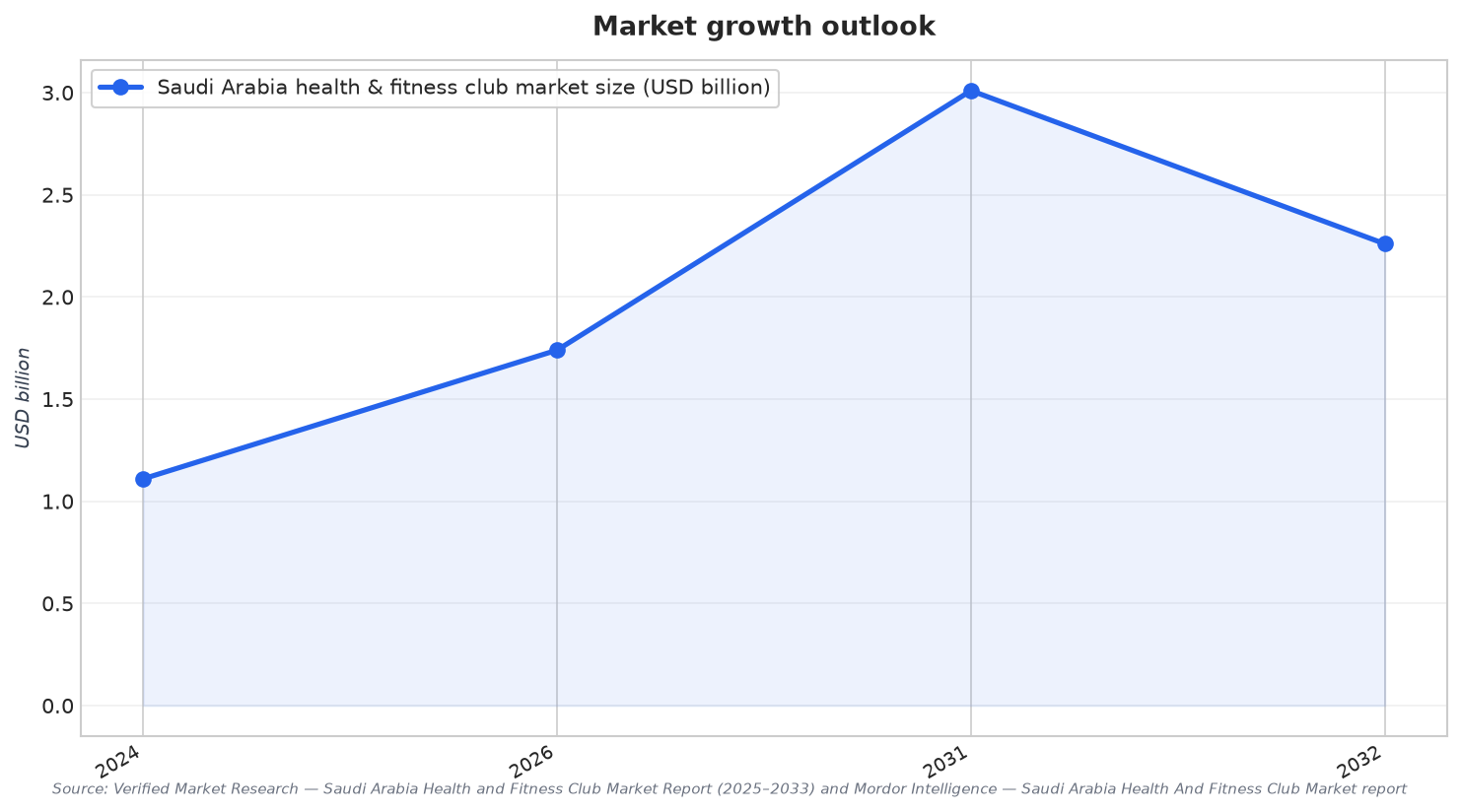
Saudi Arabia’s health and fitness club market is described as a high-growth environment across multiple reports, but the numbers vary by source and forecast window. Verified Market Research values the Saudi health and fitness club market at USD 1.11 Billion in 2024 and projects USD 2.26 Billion by 2032, with a CAGR of 9.25% from 2026 to 2032. Mordor Intelligence frames the same market at USD 1.74 billion in 2026 and forecasts USD 3.01 billion by 2031, at an 11.53% CAGR. MarkWide Research puts the market at $1.8 Billion in 2026 and projects $4.04 Billion by 2035, at a 9.40% CAGR. Treat these as directional planning inputs, then validate local demand block by block with site-level evidence.
For a boutique fitness franchise Saudi Arabia expansion plan, the structure of competition matters as much as top-line market growth. Mordor Intelligence reports that independent operators held 66.74% market share in 2025, signaling a fragmented landscape and localized decision-making on pricing, service design, and community marketing. The same source also notes that budget gyms capture the majority of members, while premium and boutique gyms and clubs are projected to be the fastest-growing segment, with a 13.32% CAGR from 2026 to 2031. That combination implies a two-speed market: value formats drive volume, while boutique concepts can win on differentiation, retention mechanics, and a clear premium proposition.
Market-Entry Signals: Policy, Licensing, and Network Growth
Government-linked signals and licensing momentum shape the timing and sequencing of entry. Verified Market Research cites Vision 2030-related support, including an allocation of USD 13.33 Billion for development of the sports and fitness sector, and states that the number of licensed fitness centers increased by 150% between 2021 and 2023. It also reports that female-only facilities showed 300% growth over the same period, citing the Ministry of Sport. Separately, an OpenPR summary of a Ken Research analysis states Saudi Arabia had approximately 1,650 commercial fitness locations in 2025, with the network forecast to reach around 2,430 locations by 2031. For franchisors, those figures support a phased rollout plan that prioritizes regulatory readiness, landlord alignment, and a repeatable playbook for site approvals.
Unit economics in boutique studios are driven by a small set of controllable levers, so standardization is the real scaling asset. Franchise Fast Track emphasizes that the core question is whether unit contribution holds after rent, labor, and marketing are deducted, and points to lease obligations, buildout, pre-opening payroll, training, and ongoing field support as recurring replication costs. The same article also highlights FDD diligence mechanics, calling Item 20 a practical tool because it lists current and former franchised locations and enables turnover analysis and reference calls. In Saudi Arabia, MarkWide Research adds that corporate wellness programs can broaden the member base and that operators may need to reconfigure pricing models and service tiers around enterprise procurement rather than purely individual subscription economics.
Scaling also requires choosing where to compete within the Kingdom’s gym mix. Ken Research notes the highest share of market is captured by “popular fitness centers,” followed by boutique centers and local gyms, and says established players are expanding to outskirts to cater to underserved areas. OpenPR’s Ken Research summary adds examples of multi-site expansion in value-oriented models, noting KUN Sports operated approximately 60 iN2 Fitness branches in 2025, and that PureGym Saudi Arabia set a target of reaching 40 locations by the end of 2025. While those examples are not boutique studios, they reinforce a critical franchising reality: repeatability and disciplined rollout cadence matter. For boutique concepts, the strategic takeaway is to build a unit model that survives rent and staffing volatility, then use partnerships and standardized operating routines to multiply that model across cities.
How fast is Saudi Arabia’s health and fitness club market expected to grow?
What does market fragmentation mean for boutique studio franchising in Saudi Arabia?
What policy and licensing signals support entry for a boutique fitness franchise in Saudi Arabia?
What network growth is expected for commercial fitness locations in Saudi Arabia?
Which unit-economics lines should a boutique franchisor stress-test before scaling?