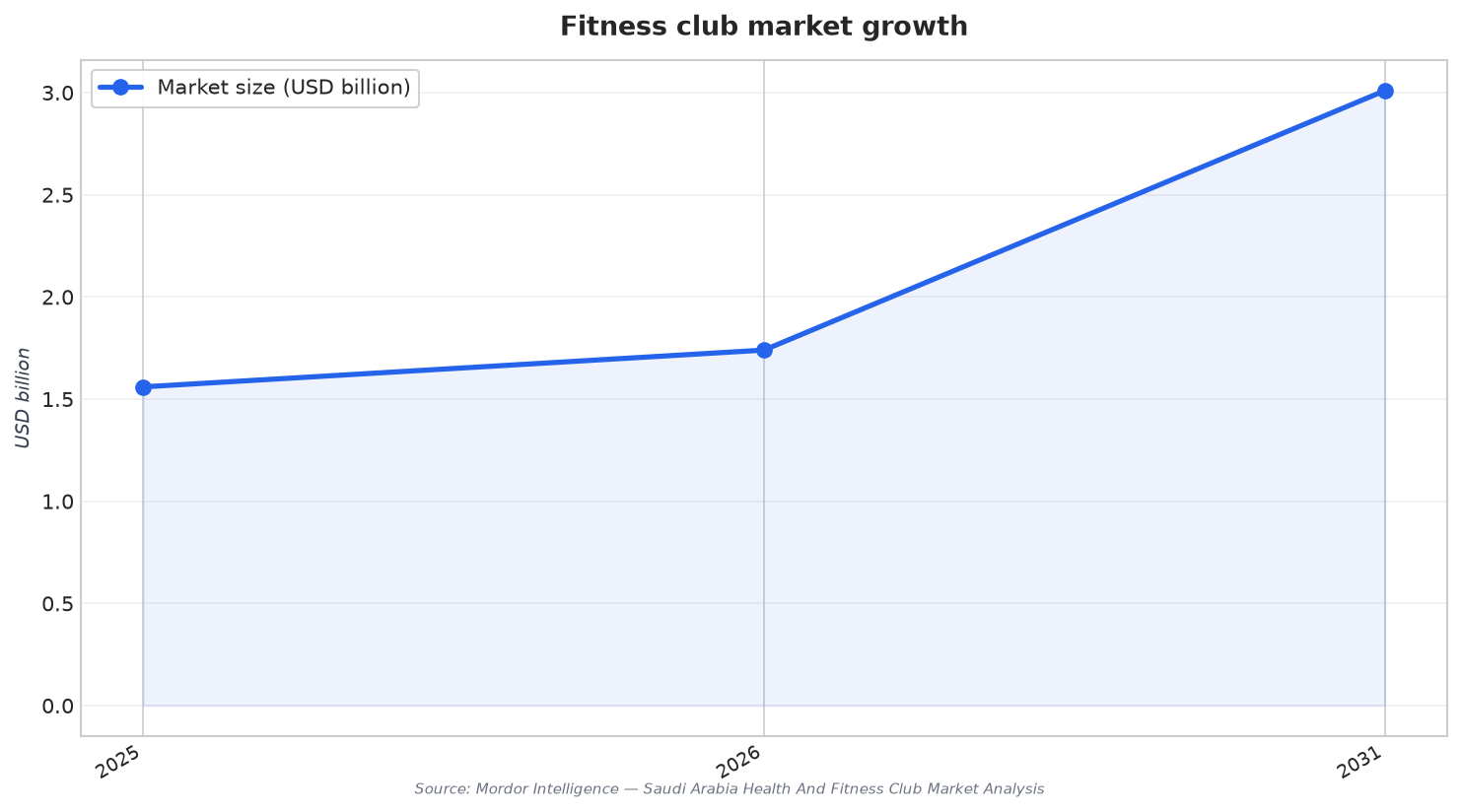
Employer-sponsored sports programs are becoming a sharper lever inside Saudi workplace wellness. Multiple signals point to stronger demand for structured activity and easier access to fitness services. The Saudi Arabia corporate wellness market was valued at USD 884.34 million in 2025 and is projected to reach USD 1,532.26 million by 2034, with a 6.30% CAGR for 2026–2034, according to an IMARC Group release. In parallel, the health and fitness club market is estimated at USD 1.74 billion in 2026, up from USD 1.56 billion in 2025, and is projected at USD 3.01 billion by 2031, with an 11.53% CAGR for 2026–2031 (Mordor Intelligence). This combination creates space for employer sports programs that connect employees to clubs, coaches, and consistent routines.
Riyadh stands out as a practical starting point for corporate sports activation, because corporate demand and club supply already intersect there. Verified Market Research states that Riyadh houses 70% of Saudi Arabia’s corporate headquarters, and reports that corporate gym memberships in Riyadh increased by 140% between 2020–2023. The same source notes that companies are investing an average of USD 932.79 per employee annually in wellness programs. It also reports that major companies increased wellness program budgets by 45% in 2023, and that the Saudi General Organization for Social Insurance reported a 160% increase in corporate wellness partnerships from 2020–2024. For workplace league operators, these figures imply faster decision cycles when the offer is packaged as an employer benefit rather than an individual purchase.
What Workplace League Operators Can Build With Clubs and Compliance in Mind
Workplace league operators can turn “membership benefits” into higher-usage sports ecosystems by integrating with how clubs already sell to employers. MarkWide Research notes that corporate packages capture sustained bulk commitments from employers investing in workforce wellness, and that corporate wellness mandates are compressing sales cycles as employers seek bulk membership contracts. The same source defines typical club operations as 2,000 to 15,000 square meters, with recurring subscription access models and services ranging across group formats and individualized delivery. Operators can align league scheduling, team registration, and seasonal play with these subscription cycles, then connect winning pathways to personal training and nutritional counseling, which MarkWide highlights as premium-priced versus standard floor access.
Execution also depends on local oversight and on-site retail rules that can shape partnership terms. MarkWide Research says the General Authority for Sports oversees facility licensing and instructor credentialing, while the Saudi Food and Drug Authority monitors nutritional supplement retail within club premises. SFDA registration requirements for on-site protein and supplement sales can create compliance thresholds that filter smaller operators, which matters when a league is hosted at third-party facilities. On the club side, the market’s revenue mix indicates where operator partners may focus: membership fees represented 79.74% of the Saudi Arabia health and fitness club market share in 2025, while personal training and instruction is advancing at a 12.95% CAGR through 2031 (Mordor Intelligence).
The corporate wellness sports Saudi Arabia opportunity is not only about adding more benefits; it is about building repeatable participation with measurable uptake. Vision 2030 is repeatedly cited as a driver of activity and wellness initiatives, including in Mordor Intelligence and an IMARC Group release. Club formats and audiences are also shifting. Mordor Intelligence reports that men accounted for 77.62% of participation in 2025, while women represent the fastest-growing cohort at a 13.05% CAGR to 2031. Budget gyms captured 64.78% of revenue in 2025, while premium/boutique clubs are expanding at a 13.32% CAGR during 2026–2031. For league operators, that means designing formats that work in value-driven settings while offering premium add-ons that clubs can upsell.
How large is Saudi Arabia’s corporate wellness market, and what is the growth outlook?
Why is Riyadh a key launch market for employer sports programs?
What evidence shows employers are increasing wellness investment in Saudi Arabia?
How can workplace league operators align with how clubs sell to employers?
What does the corporate wellness sports opportunity in Saudi Arabia need to consider on compliance?