
Saudi sports investment is often discussed as if it comes from one unified checkbook, but multiple Saudi entities operate with separate budgets and mandates. The Public Investment Fund (PIF) is Saudi Arabia’s sovereign wealth fund, governed by Yasir Al-Rumayyan, and reported to hold estimated assets of $940 billion to $1.15 trillion depending on the source. In this context, the DAZN Saudi Arabia investment story is less about a single “Saudi” decision and more about how PIF uses specialized vehicles. One of those is SURJ Sports Investment, which has been used to take an indirect but significant position in sports distribution and digital platforms.
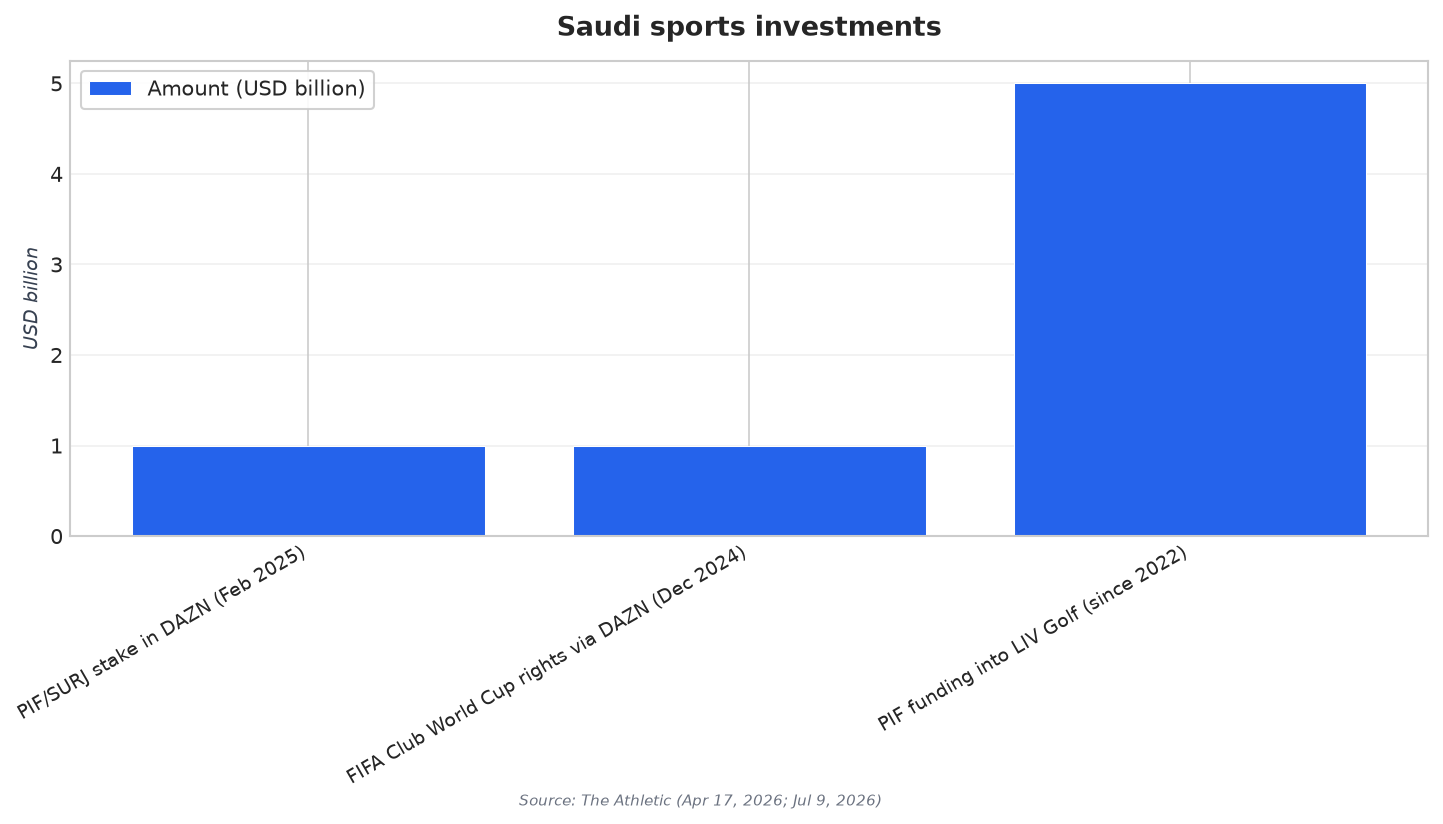
Several sources describe SURJ’s entry into DAZN as a $1 billion transaction tied to a minority stake. The Athletic reported that SURJ acquired a 10 percent stake in DAZN in February 2025. Separately, UK Companies House filings referenced by The Athletic detailed $987 million in new shares issued on April 2, 2025, in exchange for an 8.98 percent stake in the business. The same Athletic reporting said the size of SURJ’s stake has not been officially disclosed and was reported to be around 10 percent, while DAZN’s Wikipedia entry notes a “Surj Sports $1 billion investment in DAZN.” For investors, the key takeaway is that the stake is minority, but meaningful enough to shape partnership plans.
What the Partnership Is Designed to Do in MENA
SportBusiness reported that DAZN and SURJ said they would work closely to establish DAZN MENA to “unlock new broadcasting opportunities for Saudi Arabia’s growing sports sector and accelerate fans’ access to live and on-demand sports content.” The same report added that DAZN would provide SURJ with “an official streaming and broadcast partner” to showcase Saudi sport and Saudi-based events to a global audience. Yet it also noted that no deals for premium pan-regional rights had been announced by DAZN in the seven months since SURJ backing became public. Instead, DAZN agreed more global deals to offer a free showcase for events taking place in the Kingdom, while describing its Saudi and wider MENA rights investment approach as “sensible and measured.”
Investors also need to read the DAZN stake alongside other Saudi media and sports moves that affect distribution leverage. SportBusiness reported that PIF completed a SAR 7.47bn (€1.7bn/$2bn) acquisition of a 54-per-cent stake in MBC Group, which owns streaming platform Shahid. That is a separate asset from DAZN, but it underscores how Saudi capital can operate in parallel across content, platforms, and event ecosystems. BoxingInsider also reported that PIF pushed approximately $1 billion through SURJ into a minority stake in DAZN, framing DAZN as a streaming home for major promoters and Riyadh Season cards. The combined message is not simply “buy rights,” but build optionality across production, promotion, and distribution.
Finally, the DAZN-SURJ alignment lands in a period where PIF is described as recalibrating spending priorities. BoxingInsider cited a new five-year strategy that reduces PIF international investments from 30 percent of the portfolio to 18 to 20 percent, with an emphasis on domestic projects under Saudi Vision 2030. Semafor similarly reported that PIF’s 2026-30 strategy does not list sport among its priority areas, while also describing tighter constraints at some PIF-owned clubs. For sports media investors, that context matters: a minority stake in a global streamer, paired with “measured” rights spending language, can read as a distribution-first bet that is easier to sustain than open-ended, headline-grabbing outlays.
How big is the Saudi Arabia investment in DAZN?
Who is SURJ, and why does it matter for sports media investors?
What is DAZN MENA supposed to achieve?
Has DAZN announced premium pan-regional rights deals in MENA since SURJ backing became public?
How does PIF’s broader strategy affect interpretations of the DAZN stake?