Savvy Games Group is a PIF-funded vehicle built around acquisitions, investments, and commercial ventures, with an ambition to reach “leadership status in the games industry” by 2030. Multiple reports cited by Reuters have described Savvy as ready to make another billion-dollar gaming acquisition as 2026 begins. Naavik frames the structure as straightforward: Scopely anchors mobile; ESL FACEIT Group provides a major position in esports; and Steer Studios represents production capacity inside Saudi Arabia. Alongside owned assets, Savvy also stewards billions of dollars in listed gaming stakes across Japan, Korea, and the U.S., shaping exposure across public markets as well as private dealmaking.
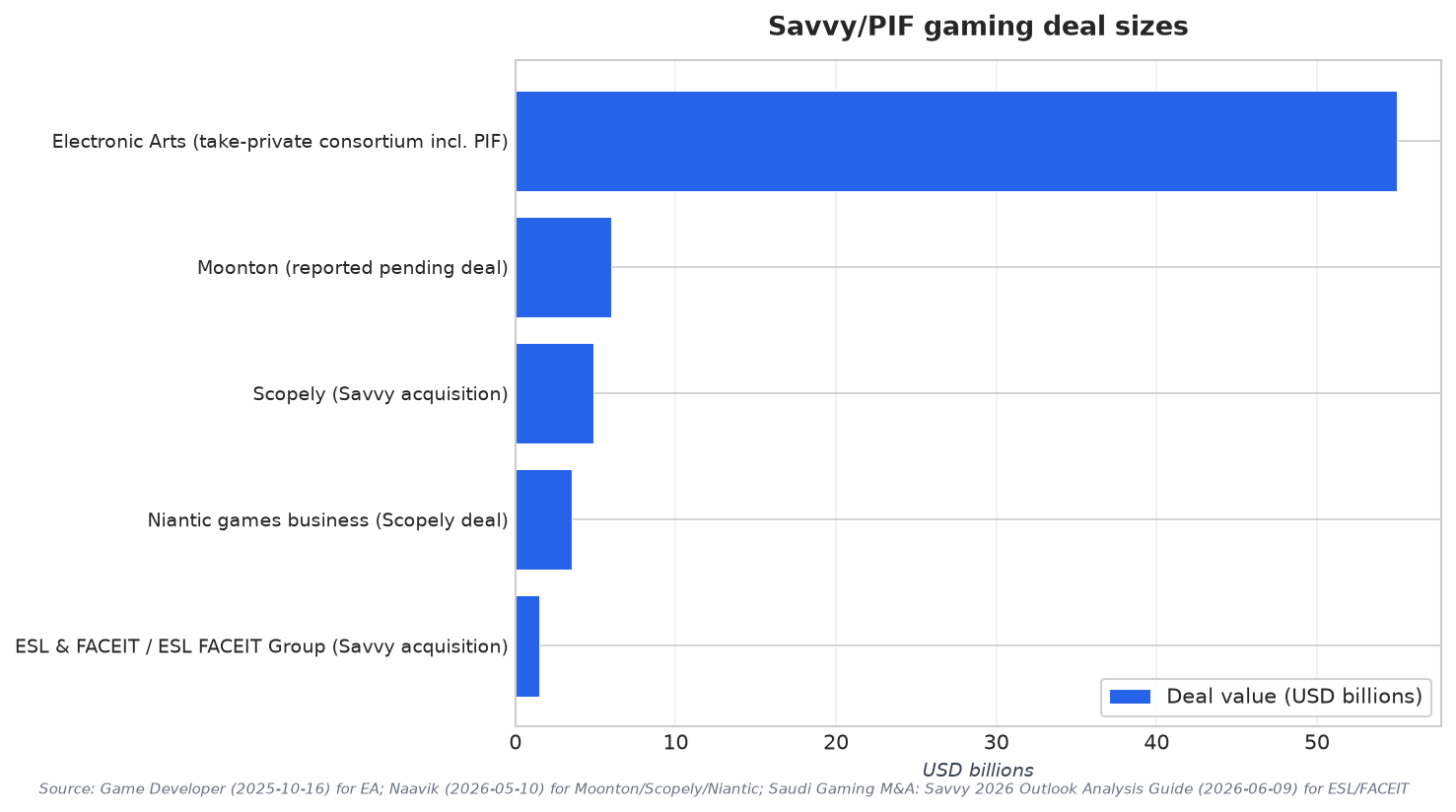
The clearest near-term signal is mobile consolidation. Reuters-cited sources said ByteDance is ready to sell Moonton Technology, and that discussions with Saudi-owned Savvy are advanced, with preliminary proposals agreed. The reported valuation range is $5 billion to $7 billion, while Naavik describes Savvy agreeing to acquire Moonton in March 2026 in a deal pending closure for more than $6 billion. Moonton’s scale is tied to Mobile Legends: Bang Bang, described as having over 1.5 billion downloads and 110 million active players each month. Coverage noted the deal, if completed, would rank as the sixth largest video game acquisition of all time, a useful reference point for investors watching transaction benchmarks.
How the Scopely Engine Turned Into a Repeatable Deal Machine
Savvy’s most cited proof-of-concept is Scopely. Savvy acquired Scopely in 2023 for $4.9 billion, after an earlier esports push that included the roughly $1.5 billion ESL-FACEIT merger that was underway by early 2022. Naavik reports Monopoly Go launched in April 2023, three months before the acquisition closed, and by November 2023 passed $1 billion in revenue. By the end of 2025, Sensor Tower estimated $6 billion in lifetime in-app purchase revenue, with the game still generating roughly $200 million a month. For investors, that cash-flow narrative matters because it helps explain how Savvy’s mobile platform could fund additional M&A rather than simply adding balance-sheet risk.
The follow-on deals reinforce a pattern of buying scale, then buying adjacency. In March 2025, Scopely signed a $3.5 billion deal for Niantic’s games business, and Naavik says it brought in Pokémon Go, more than 30 million monthly active players, and over 400 employees, with the deal closing in May. In February 2026, Scopely agreed to acquire a majority stake in Istanbul-based Loom Games, with a path to full ownership. Separately, Savvy owns ESL FACEIT Group, which merged two major esports organizers, strengthening distribution and community infrastructure alongside mobile publishing.
The EA take-private deal is the outlier that still defines the ceiling of Saudi-linked gaming M&A. Game Developer reports Electronic Arts confirmed a $55 billion take-private deal funded by a consortium of PIF, Silver Lake, and Affinity Partners, including $20 billion in debt; the ownership group collectively contributes $36 billion, with debt financed through JP Morgan Chase Bank. Naavik argues PIF helped take EA private “but not through Savvy,” suggesting deliberate distance. For additional context, Reuters commentary cited in the Savvy 2026 outlook notes the government has earmarked $38 billion for games, while Arab News PK says Saudi Arabia’s gaming market is expanding at nearly 8% annually and cites plans that include incubating 250 new game companies in Saudi Arabia and creating 39,000 jobs by 2030.
How does Savvy Games Group’s strategy map into a repeatable M&A playbook for investors?
What are the key figures behind the reported Moonton discussions?
Why does the Scopely acquisition matter to the investor case?
How was the EA take-private deal structured, according to the sources?
What Saudi domestic growth and jobs targets are cited alongside the deal narrative?