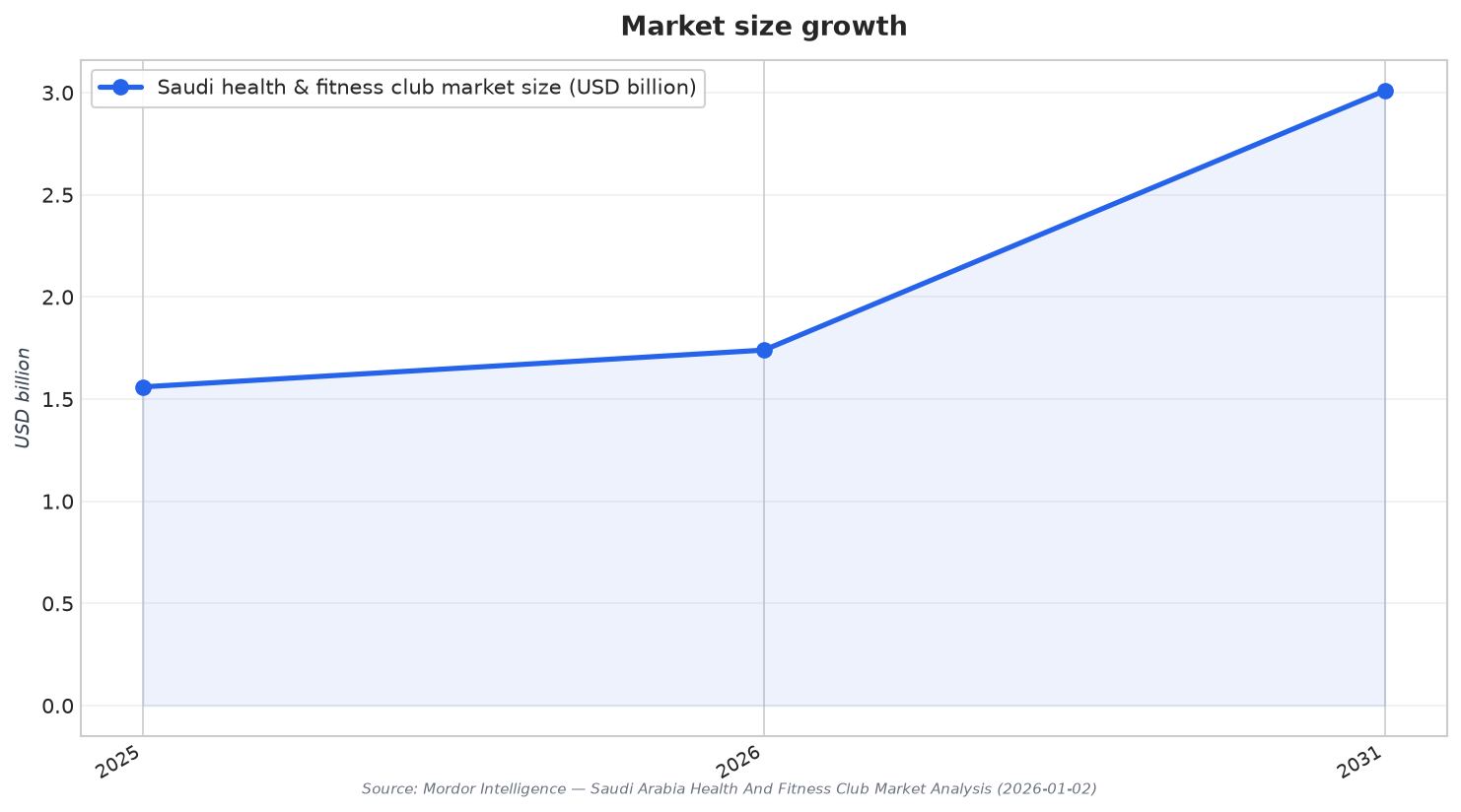
Women’s fitness clubs Saudi Arabia operators are building into a market that multiple reports describe as scaling quickly under Vision 2030 reforms and supportive regulation. Mordor Intelligence estimates the Saudi health and fitness club market at USD 1.56 billion in 2025 and USD 1.74 billion in 2026, with USD 3.01 billion projected for 2031 at an 11.53% CAGR (2026–2031). IMARC also projects the market reaching USD 2,808.2 million by 2034. For women-led concepts, the change is also regulatory: Trainera notes that Saudi Arabia announced licences for women’s gyms in February 2017, and that women’s weekly participation more than tripled between 2015 and 2019 using Saudipedia figures.
Licensing and compliance are operational design inputs, not paperwork afterthoughts. MarkWide Research states that the General Authority for Sports oversees facility licensing and instructor credentialing, while the Saudi Food and Drug Authority (SFDA) monitors nutritional supplement retail within club premises. That matters if your club plans any on-site protein or supplement sales, because MarkWide adds that SFDA registration requirements for on-site supplement sales create compliance thresholds that can filter smaller operators. Trainera also flags that licensing, tax, and data rules apply to coaches and gyms, and recommends confirming licence, VAT, and e-invoicing status with the Ministry of Sport and ZATCA, while treating progress photos and health notes as sensitive data under the PDPL.
Site Selection: Follow Zoning, Demand Signals, and Format Fit
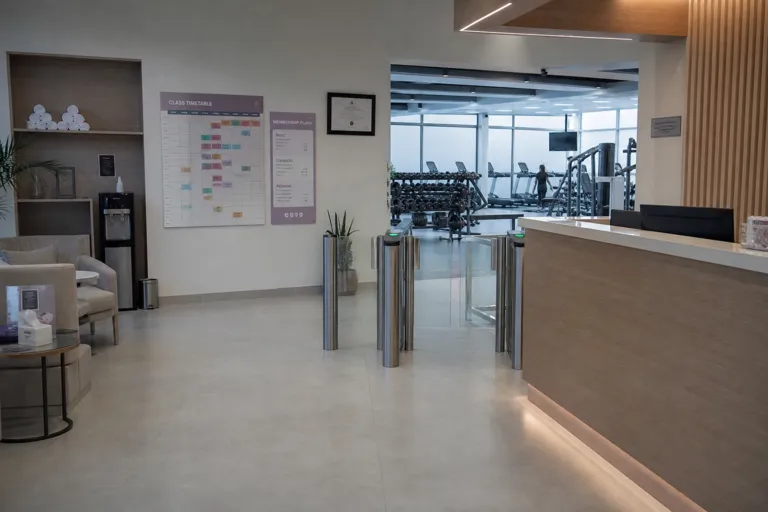
Site selection for women-only clubs is tied to zoning and the economic logic of the format you choose. MarkWide notes that municipal zoning boards in Riyadh, Jeddah, and Dammam regulate land use classifications for mixed-gender versus gender-segregated facilities, making location screening a regulatory step as well as a commercial one. Verified Market Research says Riyadh “substantially dominates” the Saudi health and fitness club market, linking demand to the city’s large and growing population and noting that many residents in middle and upper-income brackets have disposable income to invest in memberships. On the supply side, MarkWide describes typical facilities spanning 2,000 to 15,000 square meters, which helps frame feasibility against available sites, fit-out, and operating model choices.
Membership economics in Saudi clubs are membership-first by revenue, then enhanced by premium services. Mordor Intelligence attributes 79.74% of 2025 market revenue to membership fees, while personal training and instruction are advancing at a 12.95% CAGR through 2031. Club positioning also changes the math: Mordor says budget gyms captured 64.78% of 2025 revenue, while premium/boutique gyms and clubs are expanding at a 13.32% CAGR (2026–2031). Structure affects scale strategy too, with independents holding a 66.74% share in 2025, while chained facilities scale at a 12.67% CAGR to 2031. For women’s growth specifically, Mordor reports women as the fastest-growing cohort with a 13.05% CAGR to 2031, even though men accounted for 77.62% of participation in 2025.
Women-focused supply growth and membership demand are visible in deal flow and operator metrics. Verified Market Research reports that in July 2023 Body Masters Gym Chain partnered with the Saudi Sports for All Federation to invest SAR 200 million in female-only fitness centers in second-tier cities. IMARC highlights that women-focused fitness centers are rising after reforms, and adds a premium-facility signal: female gym membership numbers are now surpassing male participation rates in several premium facilities. Alora Advisory frames women’s participation as reaching 25–30% of total memberships, with projections exceeding 35–40% by 2030, while Trainera reports Leejam’s female members grew 23% in the year to June 2026 compared with 8% for all members. For demand validation at launch, IMARC cites GymNation’s pre-opening sales in Saudi Arabia of 12,000 memberships within 72 hours across its first six locations in Jeddah and Al Khobar.
What changed licensing for women’s gyms in Saudi Arabia?
Which authorities matter most when launching a women-only club?
What do the revenue economics look like in Saudi fitness clubs?
How should site selection be approached for gender-segregated facilities?
How fast is demand rising for women’s fitness clubs in Saudi Arabia?