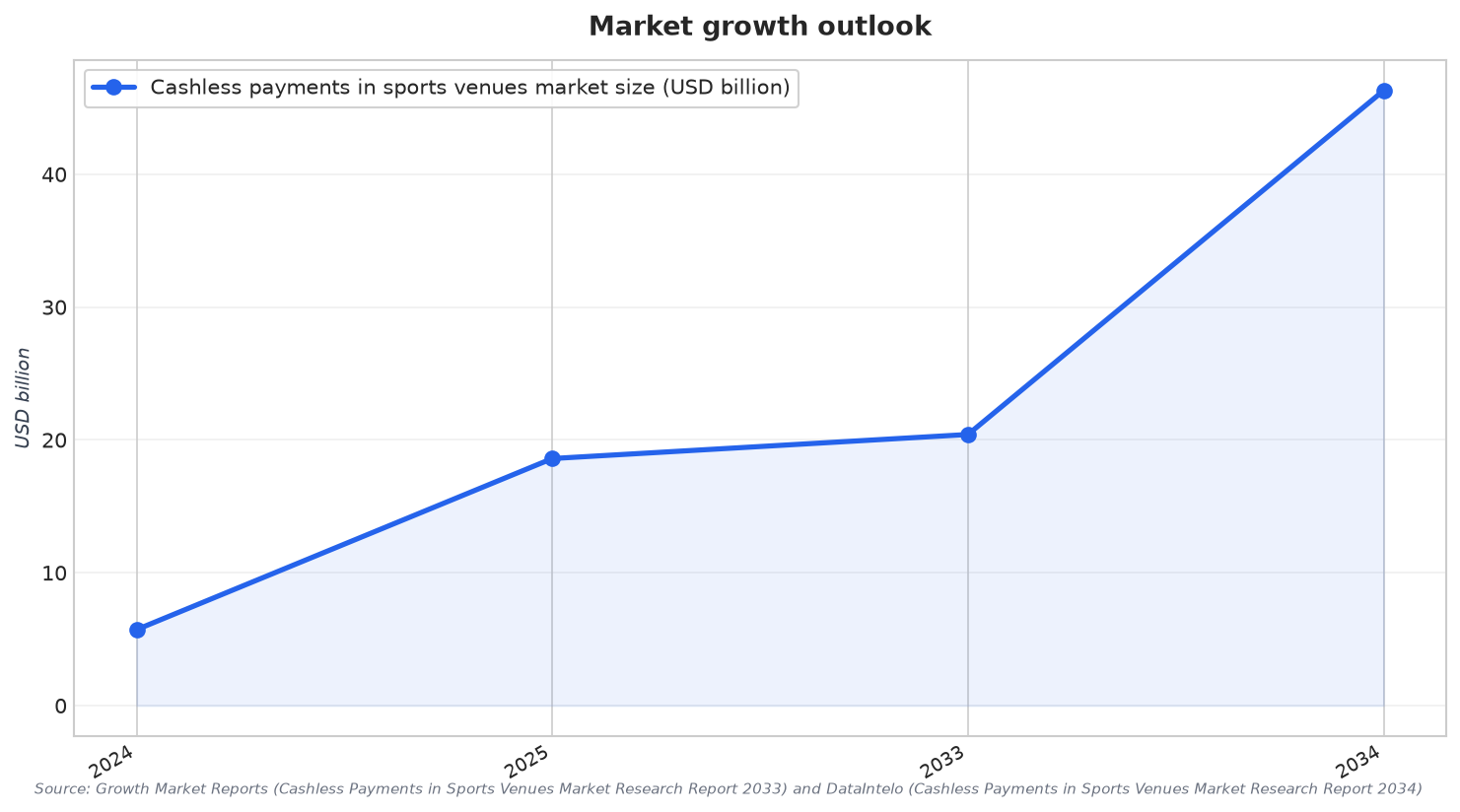
Cashless stadium models are no longer experimental. They are becoming a standard playbook for venue operators and vendors. Globally, the cashless payments in sports venues market was valued at $18.6 billion in 2025 and is projected to reach $46.3 billion by 2034, with a 10.7% CAGR for 2026–2034. Another global report sized the same market at USD 5.72 billion in 2024 and forecast USD 20.41 billion by 2033, with a 15.8% CAGR from 2025 to 2033. For Saudi venues, these figures are context, not local market sizing. But they show how quickly vendor ecosystems are scaling around mobile wallets, contactless cards, QR code payments, and wearable-based payments.
Operationally, the case for going cashless is often built around speed, cost, and data. A global sports-venue study cited that eliminating cash handling reduces operational costs by 15–20% and can accelerate transaction times by up to 40%. It also reported that, as of 2026, more than 72% of major professional sports stadiums globally had implemented some form of cashless payment infrastructure, up from about 38% in 2020. Specific venue examples reinforce what operators look for. Levi’s Stadium reported that cashless transactions account for more than 99% of its point-of-sale activity. Mercedes-Benz Stadium documented over $350,000 in operational savings and a 16% per-capita spending lift in its first fully cashless year.
What Fintech and POS Vendors Must Deliver on Matchday
Cashless is not only about tapping a card. Vendor selection increasingly centers on stadium-grade POS and orchestration that can handle compressed peak demand and multi-vendor settlement. One venue-POS perspective highlights that modern systems bundle inventory tracking, vendor management, and real-time analytics into one platform, turning vendor settlements into a query instead of a spreadsheet task. Inclusion is also part of the design brief. Reverse ATMs and clear pre-event communication are cited as practical tools to keep cash-preferring fans participating while still operating a fully digital venue. This is where matchday payments technology in Saudi Arabia becomes a vendor integration problem, not just a checkout upgrade.
Mobile ordering is also reshaping in-venue commerce, because it links ordering flows to payments and fulfillment. The global mobile ordering at stadium market was valued at $2.8 billion in 2025 and is projected to reach $8.6 billion by 2034, a 13.2% CAGR for 2026–2034. Venues that deployed mobile ordering solutions reduced queue wait times by an average of 38%. Research cited in the same market context indicates per-capita spending increases by 20% to 30% when fans can order from their seats rather than standing in queues. In the NFL context, venues using full-suite mobile ordering platforms recorded average per-fan concession revenue increases of $6.50 to $9.20 per event versus conventional ordering.
Saudi market readiness is shaped by rails, regulation, and uneven cash preferences across locations. A Saudi fintech market analysis notes that major urban centers approach cashless parity, while many rural markets still favor cash for small-value transactions. On infrastructure, the same source points to access to national rails like the Mada network and the real-time Sarie system as differentiators for fintech adoption. It also highlights the Personal Data Protection Law, effective since September 2024, which raises compliance thresholds through data residency rules and defined penalties. For Saudi venues, that means payments vendors, POS providers, and mobile ordering partners need to design around national rails and privacy compliance, while still supporting fan inclusion pathways when cash remains part of the local reality.
What does global adoption say about cashless stadium momentum?
Which results show the operational upside of going fully cashless?
How does mobile ordering change matchday commerce performance?
What should matchday payments technology in Saudi Arabia align with?
How can venues include fans who still prefer cash?